
When Thailand Takes Wing
Seasonal winds carry traditional kites skyward in a soaring display of culture and tradition
Words: Phoowadon Duangmee
Photos: Shutterstock
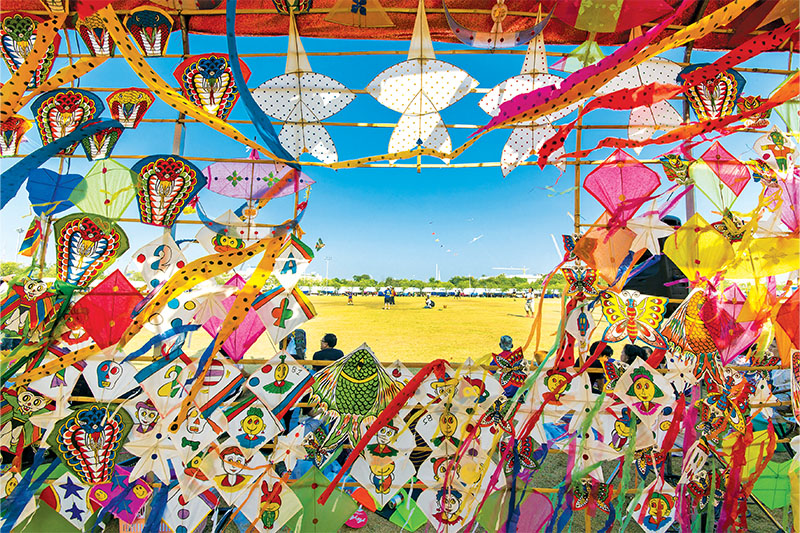
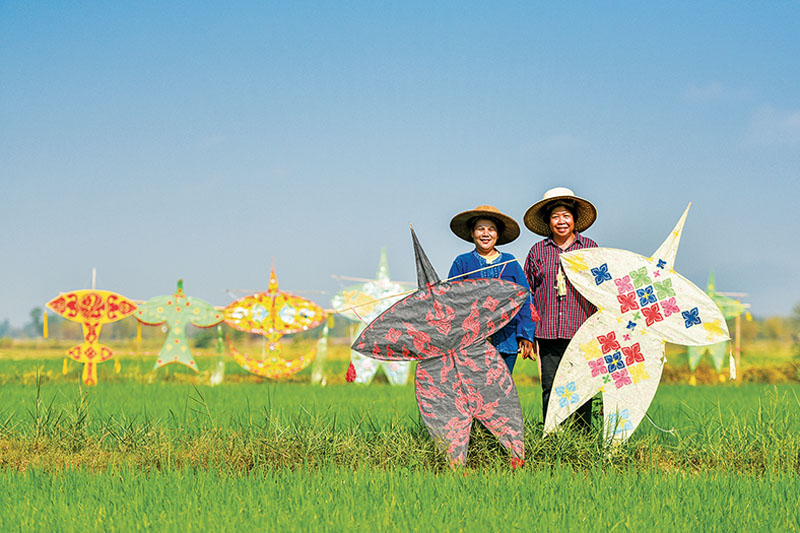
As seasonal winds sweep across Thailand’s countryside, vibrant stars and diamonds turn the skies above rice fields into a flowing tapestry of colours.
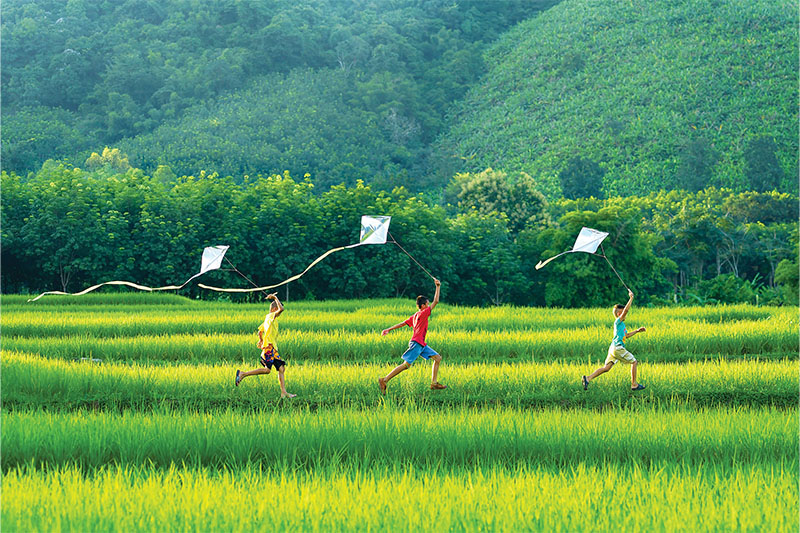
Locals fly the handcrafted kites at harvest’s end in March and April, weaving tradition with the natural cycle of life.
Traditional Thai kite flying is a subtle art rather than a spectacle. The kites rise quietly into the sky, carried by gentle breezes, an invisible string and patient hands. Children run barefoot across the fields while adults steady papered bamboo frames and elders look on serenely, having witnessed this ritual countless times before. To travellers, this may seem like a simple pastime. Yet, these airborne shapes reveal a culture forged by landscape, craftsmanship and an exquisite dance of human will and the wind’s force.
A Kingdom Carried by the Wind
Kite-flying has been part of Thai life for centuries, with angular silhouettes gracing the bright, dry-season skies from December to April. Fields and farms wind down after the harvest is gathered in, leaving a period of leisure that stretches until Songkran.
Kites are thought to have arrived in Thailand with Brahmins from India in the 13th century. From village greens to palace grounds, their varied shapes and colours have adorned Thai skies ever since. Northern chronicles recount how Prince Phra Ruang of Sukhothai met his future lover while looking for a kite lost beyond the palace walls – a chance encounter that sent romance soaring aloft.
Beyond tradition and leisure, kites have played a more serious role in warfare. During the Ayutthaya period (1351-1767), large kites were used to carry makeshift bombs – clay pots filled with gunpowder and a spark – over fortified walls. When peace returned, these flying weapons reverted to symbols of play, skill and prestige.
Kite flying entered a golden age during the reign of King Chulalongkorn (1868-1910). The monarch was a devoted patron of the sport, overseeing an era of competitions and prized trophies centred on Bangkok’s ceremonial heart of Sanam Luang, now considered the traditional home of Thai kite-flying.
Harnessing the Wind
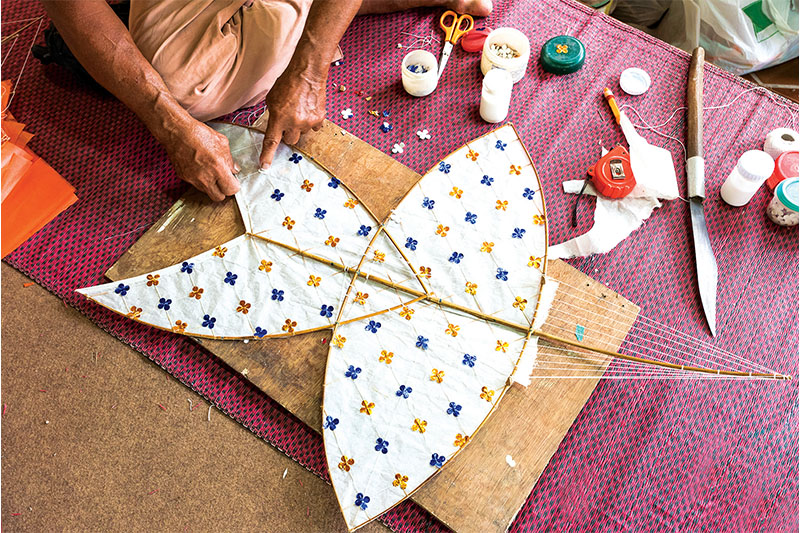
Before a kite rises, it must be meticulously crafted by hand – a ritual as fascinating as the spectacle overhead. Bamboo is carefully measured, split and shaped to achieve a precise balance of strength and flexibility, before being covered with kite paper made from bamboo cellulose.
The craft of kite-making is passed down through generations and requires painstaking attention to detail. If the frame is too rigid, it snaps; too loose, it won’t take off. Every joint, every length of string, plays a crucial part in how the kite responds once it meets the wind.
In many communities, kite-making is a shared craft. Elders guide younger hands, teaching them not only how to build, but when to fly, where to stand and how to read the currents of air. Knowledge is passed on through practice, becoming part of a living story.
Battles in the Sky
Among Thailand’s many traditional kites, two soar as cultural icons: the Chula and the Pakpao. They are seen as rivals, though their battles are defined by finesse rather than force.
The Chula is large and star-shaped, with expansive wings supported by a carefully balanced bamboo frame. Traditionally flown by teams, it demands coordination and collective control. Once aloft, it appears composed and authoritative, commanding the sky with steady grace.
The Pakpao, in contrast, is smaller and lighter, flown by a single handler. Agile and quick, it darts and circles with purpose as it tries to ensnare the Chula’s string in traditional contests – testing timing, precision and tactical intelligence.
These aerial encounters once drew huge crowds to open fields, where cheers and laughter punctuated every swoop and swerve. Victory mattered less than the battle itself
– a demonstration of craftsmanship, teamwork and strategy – values deeply embedded in Thai culture.
An Aerial Map
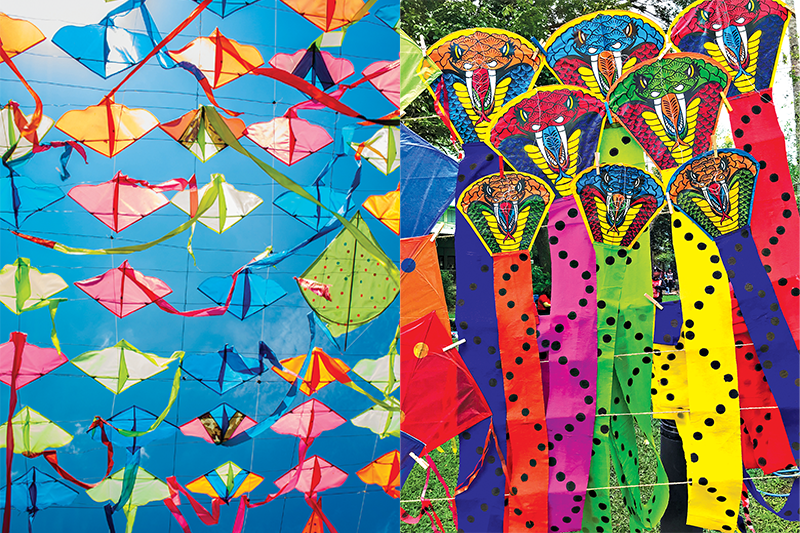
Beyond the Chula and Pakpao, Thailand’s kite-flying traditions are rich and varied, shaped by geography and wind patterns.
In the North, the E-Lum traces a graceful diamond against the sky, its gossamer paper balanced by twin tufts and a trailing tail. In Sukhothai, the Phra Ruang – reminiscent of the Chula – is entwined with local craftsmanship and the centuries-old tale of royal romance.
The central plains, with wide-open fields and steady winds, favour large Chula kites that dominate the skyline. In the Northeast, the Dui-Dui resemble smaller versions of the Chula with twin palm-leaf tails for stability and a curved bamboo head, strung to make a “dui-dui” sound as the wind passes through its tails.
In the South, kites reflect rhythms of land and sea. Buffaloes, birds and crescent moons are forged from bamboo and paper. Highlights include the moon- shaped Wong Duean (or Bulan), Satun province’s buffalo-shaped Hua Khwai and, in the far South, the ornate Amas kite, named for its intricacy.
Together, these variations form an airborne map of Thailand – each kite shaped by its environment, materials and local customs. To see them all in flight is to witness a country expressed in graceful movement rather than rigid boundaries.
Looking up, Today
Traditional Thai kites are enjoying a revival. Festivals and cultural events nationwide celebrate kite-flying as both heritage and spectacular contemporary display. Beaches, riverbanks and parks become temporary galleries where classic shapes share the skies with modern innovations – some monumental in scale or illuminated for night-time displays.
Artists continue to reinvent classic forms, unspooling new inventions that remain anchored in tradition. For travellers, such moments offer an easy entry into Thai culture – no prior knowledge required, just a willingness to pause, feel the breeze and look up.