
A Courtly Confection
Western baking traditions met local ingredients in King Narai’s court and gave birth to Khanom Phing
Words: Sarita Urupongsa
Photo: Shutterstock
Many of Thailand’s traditional desserts originated in the kitchen of a remarkable woman who rose to fame over 300 years ago in the Ayutthaya Kingdom.
Maria Guyomar de Pinha – also known by her Thai name, Thao Thong Kip Ma – was a Siamese woman of mixed Portuguese, Japanese and Bengali descent married to Greek adventurer Constantine Phaulkon, counsellor to King Narai.
After Phaulkon was executed following an uprising against the king, Maria was put to work it the royal kitchens – where she got busy writing a sweet new chapter in Thai culinary history.
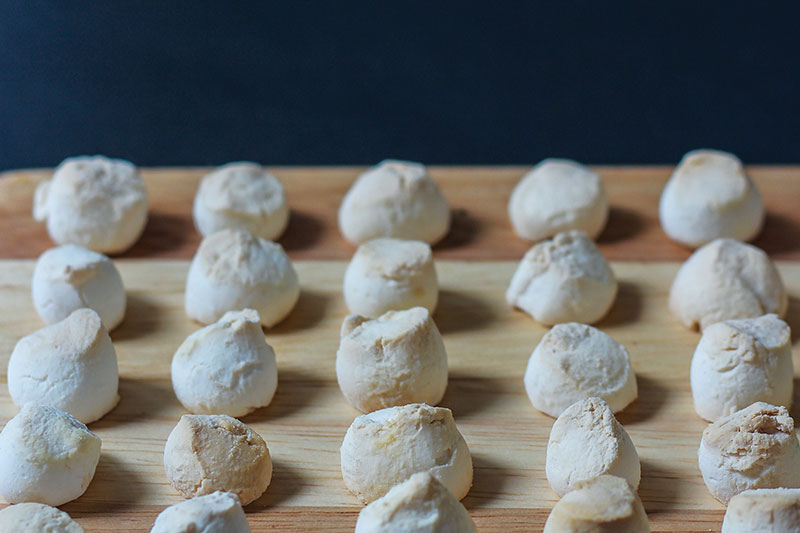
Today, she is famous as the woman who introduced Western-style desserts to the people of Siam. Among her inspirations was Broinhas, a spiced pumpkin cookie popular in Portugal. However, Maria faced one big challenge: how to recreate the recipe with local Thai ingredients. She substituted wheat flour with tapioca starch and added rich, fragrant coconut milk for a silky texture and unmistakable aroma, before baking the mixture Western-style. Served hot from the oven, Khanom Phing became a big hit in the royal court.
Phing describes the method of slow-baking the tiny cookies on iron trays, resulting in pale ivory balls with a soft golden tint that crunch before melting in the mouth, leaving a mellow sweetness and comforting coconut flavour.
Khanom Phing stands out for the simplicity of its ingredients and cooking method. But patience and care are required to achieve the perfect balance of flavour, shape and melt-in-your-mouth texture.
To create these tiny treats, tapioca flour is dry-roasted in a pan and then set aside to cool. In a separate pan, coconut milk and sugar are stirred gently together to create a thick and slightly clumpy mixture. The flour is then folded into the sweet coconut milk with an egg. The mixture is kneaded into a soft pliable dough and left to rest for at least 10 hours – long enough to infuse the cookeis’ delicate flavour.
The dough is then pinched and rolled into tiny balls, which are placed on a baking tray in a conventional oven (heat from both top and bottom) until lightly golden.
Traditionally, the cookies are gently infused overnight with candle smoke, creating a golden hued, lightly fragrant and completely irresistible snack by morning.