
Dancing with Giants
Inside the aquamarine heart of the Maldives’ Baa Atoll, lunar tides and monsoon winds collide to set the stage for a manta ray and whale ballet
Words Pinanong Panchuen
Photos Jariya Posayajinda, Changnoi Diving, and Shutterstock
In the turquoise heart of the Maldives, a crescent-shaped bay stages a spectacle so extraordinary that it can change something deep wtihin you. Two of the ocean’s most magnificent creatures perform a rhythmic dance in a natural arena flooded by a luminous glow seen nowhere else on Earth.
It appears just after dawn, when the Indian Ocean is still and the sky above Baa Atoll shifts from grey to gold to an impossibly limpid blue. Look down from the edge of a dhoni and you can see the floor of the ocean through waters as clear as glass. And somewhere there, hundreds of manta rays are winging.
This is Hanifaru Bay – a UNESCO Biosphere Reserve tucked within Baa Atoll, some 100 kilometres north of Malé, and one of the most astonishingly beautiful stretches of ocean on the planet. The bay is shaped like a spoon: a long, narrow channel opens into
a shallow bowl enclosed by coral reefs. On the surface, it appears almost unremarkable – until the southwest monsoon arrives and transforms everything.
Between May and November, monsoon winds shift the Indian Ocean’s currents westwards, turning Hanifaru Bay into a giant net. As plankton blooms, manta rays and whale sharks glide in for the feast, as if answering an invitation to a grand banquet. Visitors fortunate enough to slip underwater on the right day, at the right time, and under the right phase of the moon, will witness one of nature’s most spectacular
hidden wonders.
Nature’s Grand Design
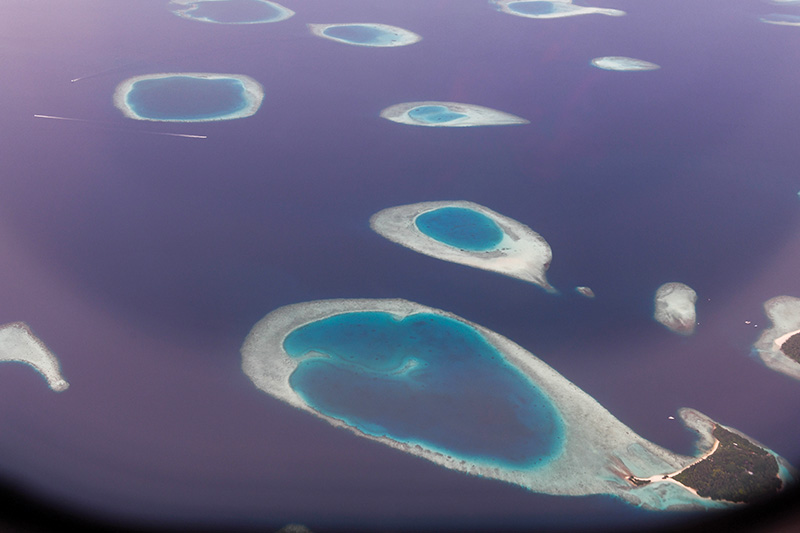
The Maldives is a geological improbability: 1,192 islands scattered across 26 atolls – ring-shaped coral formations that encircle shallow lagoons of ethereal beauty. The country spans around 800 kilometres from north to south, yet its highest point is barely 2 metres above the sea. This is a nation made almost entirely of horizons.
Baa Atoll sits in the north of the archipelago, and Hanifaru Bay nestles within it like a secret. By June, the bay begins to fill with vast clouds of plankton. Unlike the shimmering, sequin-like drifters found elsewhere, the plankton here is darker and very much alive – black-bodied krill that bite, stain the water like ink, and are swallowed by manta rays by the tonne.
Gathering of Giants
A veteran of the deep, underwater photographer Jariya Posayajinda has captured marine wonders from the Red Sea to tropical coral reefs. But when describing Hanifaru Bay, she becomes hushed, reluctant to disturb a sacred memory.
“There were hundreds of them. You hide behind a rock and stay absolutely still, because they don’t come in single file but like a wall,” she says.
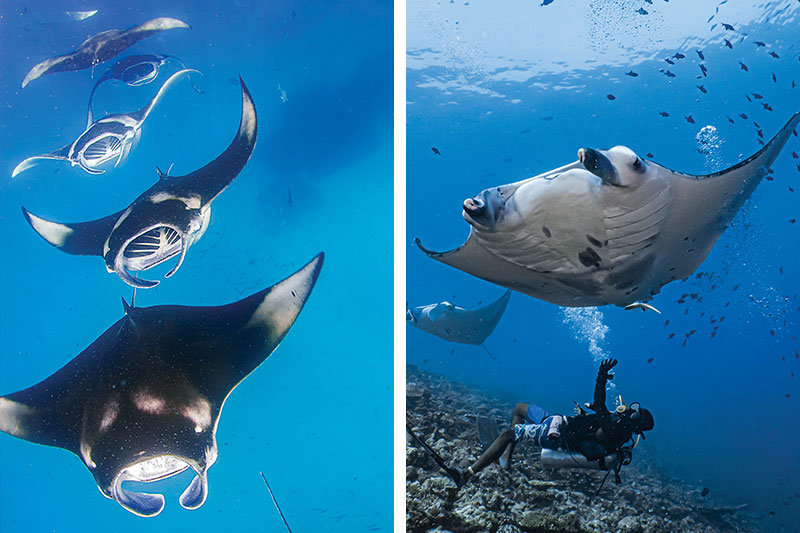
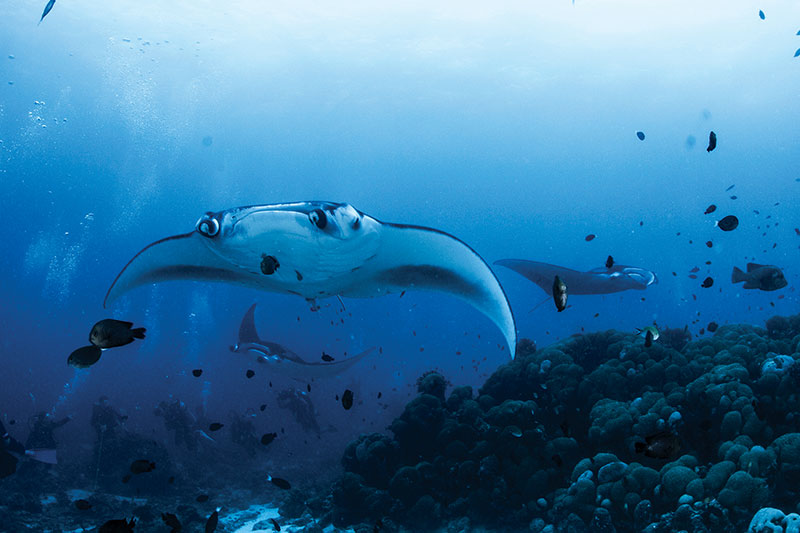
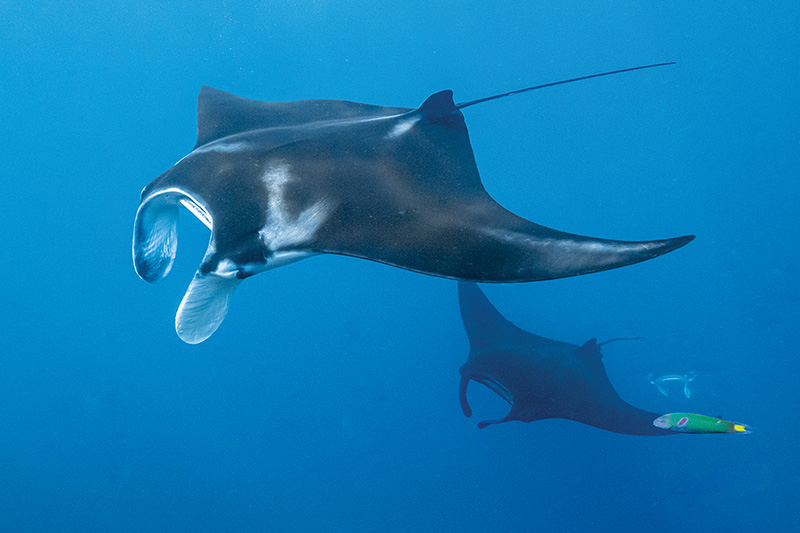
The plankton wall parts to reveal reef manta rays (Mobula alfredi), ocean giants with a wingspan of 3 to 4 metres. Moving in formation to filter the plankton, they resemble a thunderstorm blowing in – black, deliberate, and spectacular.
What Jariya captured through her lens while wedged behind a rock is known as “cyclone feeding”. The manta rays form a loose spiral, each tilting its great cephalic fins forward to funnel the plankton into its cavernous mouth as they revolve together like a slow- motion tornado. The effect, says Jariya, was like watching a prehistoric ritual choreographed by the tides.
“They were gliding in circles, opening their mouths, scooping… it was like watching them dance… an underwater ballet. I forgot about my camera and just watched, fascinated.”
Jariya advises other visitors here to keep their fingers crossed and carry a camera. Nature’s grandest spectacles don’t follow a schedule, but the uncertainty only makes their arrival more extraordinary. In Hanifaru Bay, patience is often rewarded with a miracle.
Swimming with Giants
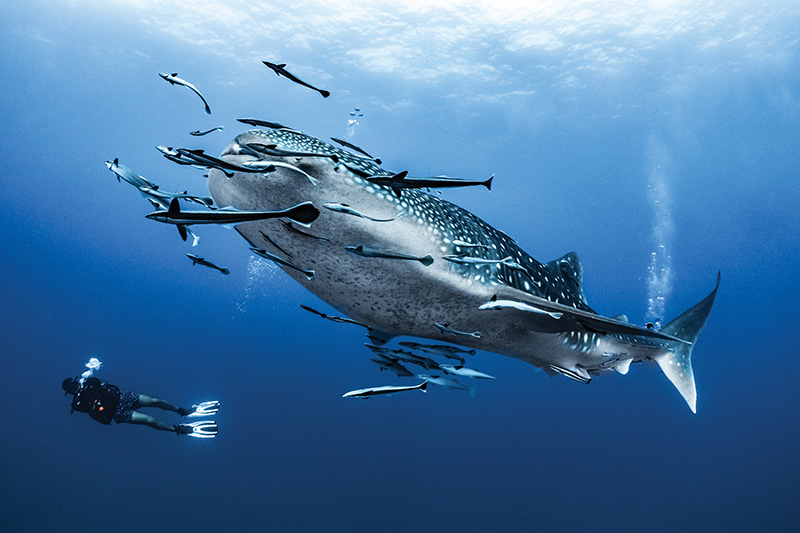
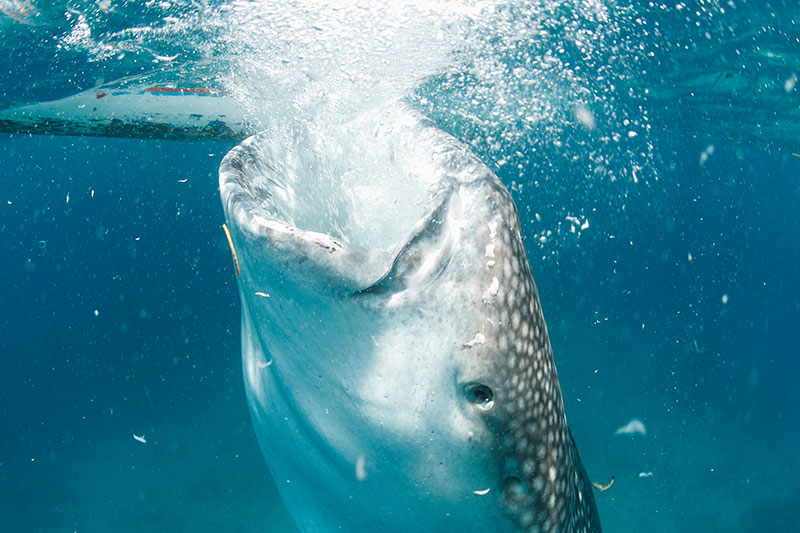
If manta rays are the bay’s ballet dancers, then whale sharks are its prima donnas. Moving slowly and with a vast gravity, their sheer size requires a mental shift to process. The Rhincodon whale shark is the largest fish in the ocean, commonly reaching up to 10 metres long – though they can double in size at full maturity and weigh over 20 tonnes. These grey creatures, with pale white or yellow markings, glide serenely by like sleek airships.
Like the manta ray, they arrive in Hanifaru on the plankton tide and are indifferent to humans if left undisturbed.
“Some stop to rest on the ocean floor, but if you rush towards them, they simply swim away. The best way to enjoy them is to float completely still and wait for them to come to you. The view of an approaching whale shark is majestic,” Jariya says.
Snorkelling is the only way to encounter manta rays and whale sharks in Hanifaru Bay; scuba diving is banned because air-tank bubbles disturb the shy giants. The secret is to hover just below the surface, embracing a quiet intimacy with only a mask and snorkel separating you from these magnificent creatures.
Travellers seeking to dive deeper with whale sharks can head to Ari and South Ari atolls, where scuba encounters are permitted all year round. North Malé Atoll is another reliable option during the season.
The Moon and the Sea
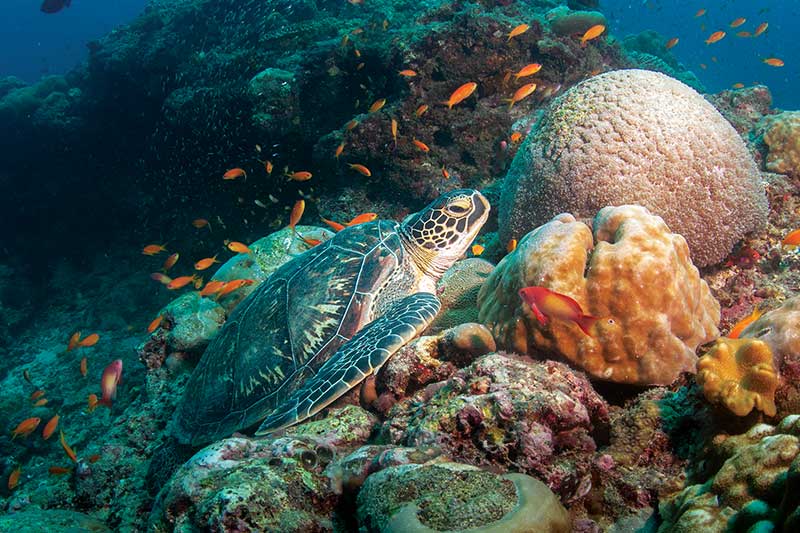
At Hanifaru, timing is everything. Experienced divers and marine photographers keep two things handy: a tide chart and a lunar calendar. High tide brings clearer water, greater visibility, and deeper blues – a perfect setting to capture pin-sharp images. The best time is typically three to five days either side of a full or new moon, when stronger tides drag in fresh blooms of plankton.
Boats and liveaboards from Baa Atoll resorts queue for scheduled entry windows – the bay’s UNESCO status means access is limited, visitor numbers controlled, and the ecosystem given room to breathe. It’s easy to feel resentful of these regulations when you’re on a waiting list, but impossible not to respect them when you are underwater and captivated by the pristine wildlife.
Dress Code: All Black
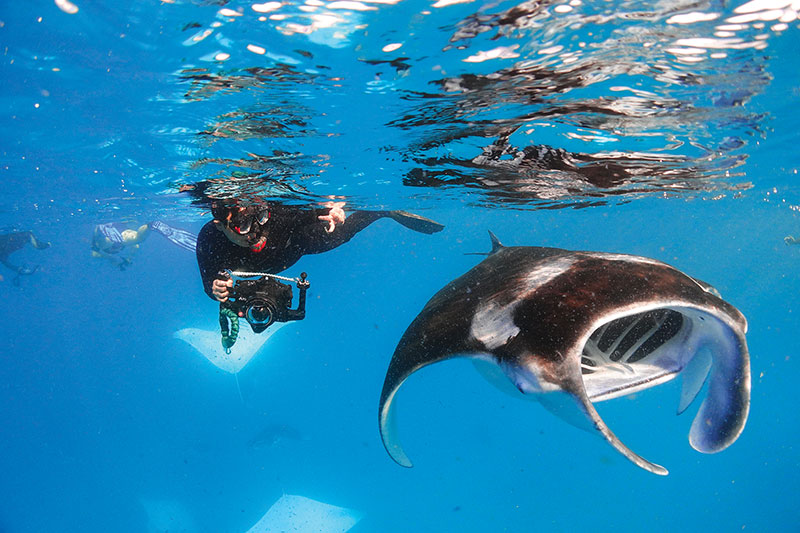
Though it sounds like the dress code for a posh dinner, underwater photographers make it a point to don all black. Wetsuits, gloves, and fins must all be dark, as pale skin can be perceived by marine life as distressed – something even the gentlest sharks are wired to investigate. A full-body black wetsuit allows you to disappear into the shadows, capturing the raw beauty of the underwater scene.
What You Take Home
The true scale of Hanifaru Bay cannot be gauged in wingspan measurements, migration distances, or lunar tide charts. This is one of the few remaining places on our planet where nature still reigns and we, in our smallness, can only watch in silent awe.
The moment a manta ray glides just a few feet overhead – silent, slow, its white belly catching the filtered light – you learn a humbling lesson in proportion. As a whale shark turns towards you in the deep, its tail sweeping through a wide, slow arc, you understand viscerally that we are visitors in a world that predates us by several hundred millennia.
Visitors leave Hanifaru with memory cards stuffed with images and tired muscles from hours of snorkelling. Yet, they also carry home something more profound: a revelation of natural grandeur, a clear sense of their place within it, and an urgent need to preserve it.
The Maldives will not be around forever. Its islands are losing ground to a rising sea; its reefs are under pressure from warming oceans. But the banquet at Hanifaru Bay continues, for now, in a cycle that will endure as long as the plankton blooms, the reefs stand, and the bay is protected.
So, go. Float. Be still. Wait. Let the giants come to you.
Diver’s Field Notes
MANTA RAY (Mobula alfredi)
Season at Hanifaru Bay: May to November (Peak: June to October) Average wingspan: 3 to 4 metres. Largest recorded 6.7 metres, weighing 1,350 kilograms
Diet: Zooplankton, including large, dark krill that cloud the bay during monsoon Behaviour: Cyclone feeding, when hundreds spiral in overlapping circles to maximise intake
Temperament: Gentle and non- aggressive, provided their feeding path is not blocked
WHALE SHARKS (Rhincodon typus)
Season at Hanifaru Bay: May to November (Peak: June to October)
Can also be spotted year-round at: Ari Atoll, South Ari Atoll, North Malé Atoll – scuba diving permitted
Size: Average 5 to 10 metres long; fully grown can expand 20 metres and weigh 20-plus tonnes. They are considered the largest fish on the planet
Diet: Plankton and small fish, they are filter feeders, not predators International Whale Shark Day: August 30
Visitor Guidelines: Hanifaru Bay
- Snorkelling Only: Scuba tanks are prohibited. Use fins that do not kick up sediment to maintain water clarity.
- Keep Your Distance: No touching or chasing. Stay still and let the animals approach you on their terms.
- Dress Code: Wear black or dark colours. Pale skin can be perceived by marine life as something dead or distressed.
- Timing is Everything: Consult the lunar calendar. The best visibility occurs three to five days before or after a full or new moon.
- Authorised Access: Book only through licensed Baa Atoll operators. Entry is strictly controlled and restricted to protect the ecosystem.
- Practice Patience: Marine life is unpredictable. You may see 50 manta rays or just two – nature does not negotiate.
Getting There
Fly Bangkok Airways from Suvarnabhumi Airport to Velana International Airport, Malé. Speedboat or seaplane transfer to Baa Atoll resorts. Journey can vary from 30 to 75 minutes depending on location of resort.