
Of Earth and Artistry
From the hidden valleys of Chiang Mai to the workshops of Siem Reap, Southeast Asia’s crafts are rooted in the landscape – just like the artisans themselves
Photo: Shutterstock
Handcrafted items carry a weight that no scale can measure. Beneath the silk, the clay or the wood lies silent hours spent crafting: the rhythmic repetitions, the small adjustments, the quiet patience to get it “just right”. This invisible art sings loudest when you’re travelling through Southeast Asia. Here, the journey of discovery is no longer about picking up a souvenir, but entering the flow of age-old local traditions and artisan communities.
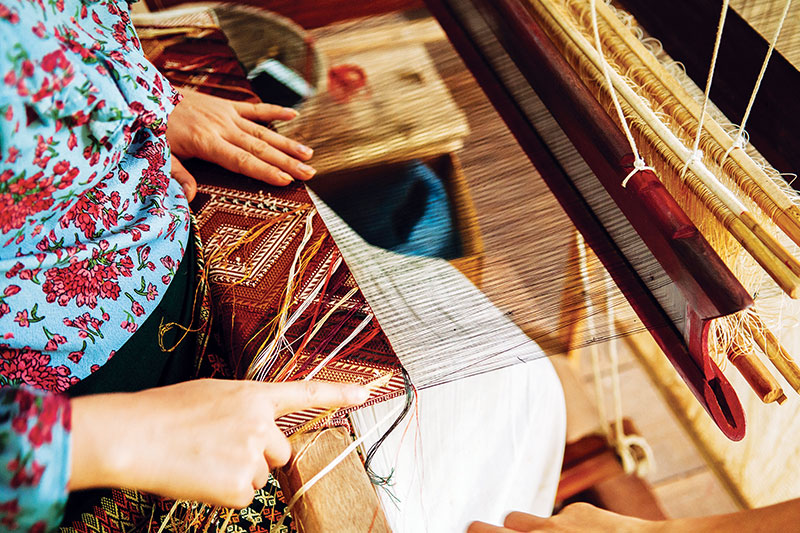
In Chiang Mai, this journey stretches beyond the city walls. In the villages of Mae Chaem – tranquil valley in the shadow of Doi Inthanon mountain – the air is thick with the steady clack-clack of wooden looms. Beneath the shade of stilt houses, cotton and silk are dyed in small bathces of inky-black indigo and a deep crimson from the bark of sappanwood and red earth. These mountain colours are soft and earthy, but resilient as the rocky slopes where they were born.
Ask a weaver how long it takes to finish a piece and they will often give you a mysterious answer. “It depends on the rain”. The mystery is solved when you know that humidity changes the tension of the threads. The rhythm of work must follow the movement of the clouds.
Across the border in the old Laos capital of Luang Prabang, the art of weaving is as ancient as the green hills.
Intricate textiles appear folded in market stalls, draped over wooden railings, and worked on during slow afternoon hours. Patterns are passed down through generations, yet artistry is more important than rigid formulas. There’s always room for a different hue or a tighter motif – the subtle signature of a particular weaver.
Ask about a mythical creature woven into a silk panel and the vendor will likely chuckle. To them, the meaning matters less than the unbroken thread of tradition stretching back to the days of their ancestors.
In Cambodia’s Siem Reap, the story is different – one of resilience after trauma. Workshops on the town’s outskirts are resurrecting skills from the brink of extinction, including stone carving, lacquering, and weaving. Intense concentration etches the faces of young artisans as they lean over their work. On a carved sandstone figure, you might still see faint pencil markings – guidelines that haven’t yet been smoothed away.
Across the region, the common thread is scale. Materials are sourced nearby, production remains small, and knowledge lies with humans rather than automated systems. Work moves at a slow pace, defying the frantic production lines of the modern world.
We often measure sustainable travel by carbon footprints and flight paths. Yet, sustainability is often found in smaller, tactile decisions. A hand-loomed cloth, a carved figure or a lacquered bowl – these are not mere souvenirs. They carry the story of where they were made, how and by whom. Taking one home feels less like a transaction and more like being let in on a secret.