
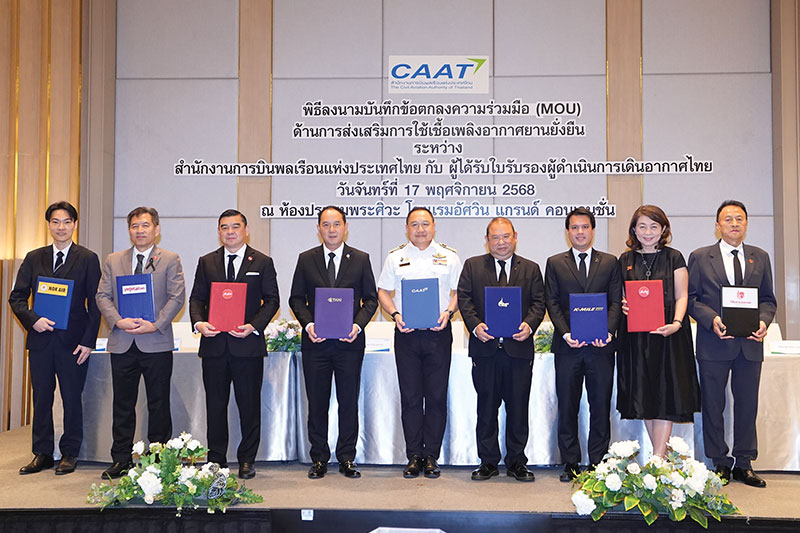
Bangkok Airways Signs MOU for Sustainable Thai Aviation
Bangkok Airways’ President, Mr Puttipong Prasarttong-Osoth joined senior executives from seven other Thai airlines in signing a memorandum of understanding (MOU) to promote the adoption of Sustainable Aviation Fuel (SAF).
The signing ceremony was hosted by Civil Aviation Authority of Thailand and presided by Air Chief Marshal Manat Chawanaprayoon, Director General of the Civil Aviation Authority of Thailand (CAAT), along with Mr Saran Benjanirat, CAAT Deputy Director General. The event was held at Asawin Grand Convention Hotel in Bangkok recently.
This collaboration brings together CAAT and eight airlines – Bangkok Airways, Thai Airways, K-Mile Air, Nok Air, Thai AirAsia, Thai AirAsia X, Thai Lion Air, and Thai VietJet Air – to support Thailand’s goal of achieving Net Zero Carbon Emissions by 2050. The airlines will adopt sustainable aviation practices under guidelines set by the International Civil Aviation Organisation (ICAO) and the Carbon Offsetting and Reduction Scheme for International Aviation (CORSIA), which Thailand joined at its launch in 2021.
In his remarks, Mr. Puttipong said that Bangkok Airways’ mission has long been rooted in sustainable business practices and reducing its carbon footprint. He added that the MOU marks another significant step in promoting the use of SAF, a proven way of reducing carbon emissions.
The airline first began using SAF as part of its “Low Carbon Skies” initiative, which was announced in June 2024, and adopted it for regular commercial flights on July 1 this year. “Low Carbon Skies” serves as a key mechanism driving Thailand’s aviation sector towards tangible sustainability, while also benefiting passengers by offering them greener service standards and a role in environmental stewardship.
Meanwhile, CAAT has acknowledged the rising energy costs associated with adopting SAF and said it is considering a separate carbon surcharge for international routes, to be applied on a voluntary basis by airlines. The surcharge, expected to be implemented in 2026, will reflect the cost of carbon reduction and offsetting within Thailand’s aviation sector. CAAT will oversee the process to ensure transparency and alignment with international standards, supporting Thailand’s transition to sustainable aviation across
all dimensions.
สายการบินบางกอกแอร์เวย์ส โดยนายพุฒิพงศ์ ปราสาททองโอสถ กรรมการผู้อำนวยการใหญ่ฯ ได้เข้าร่วมพิธีลงนามในบันทึกข้อตกลงความร่วมมือว่าด้วยการส่งเสริมการใช้เชื้อเพลิงอากาศยานยั่งยืน โดยมี พล.อ.อ.มนัท ชวนะประยูร ผู้อำนวยการสำนักงานการบินพลเรือนแห่งประเทศไทย (กพท.) และ นายศรัณย เบ็ญจนิรัตน์ รองผู้อำนวยการฯ พร้อมด้วยผู้บริหารระดับสูงของ 8 สายการบินของประเทศไทย ร่วมลงนาม ณ โรงแรมอัศวิน แกรนด์ คอนเวนชั่น กรุงเทพฯ เมื่อเร็วๆ นี้
ความร่วมมือครั้งนี้มีเป้าหมายเพื่อสนับสนุนการเปลี่ยนผ่านของอุตสาหกรรมการบินของประเทศไทยสู่ “การบินยั่งยืน” และการบรรลุเป้าหมายการปล่อยคาร์บอนสุทธิเป็นศูนย์ ภายในปี 2593 ตามแนวทางขององค์การการบินพลเรือนระหว่างประเทศ (ICAO) และภายใต้กรอบมาตรการลดและชดเชยการปล่อยก๊าซคาร์บอนไดออกไซด์ของภาคการบินระหว่างประเทศ ที่ประเทศไทยเข้าร่วมโครงการนำร่องตั้งแต่ปี 2564
นายพุฒิพงศ์ ปราสาททองโอสถ กล่าวว่า ด้วยพันธกิจสำคัญของสายการบินบางกอกแอร์เวย์สที่มุ่งมั่นในการดำเนินธุรกิจอย่างยั่งยืน และเล็งเห็นถึงความสำคัญของการลดผลกระทบต่อสิ่งแวดล้อม โดยเฉพาะการลดการปล่อยก๊าซเรือนกระจกจากภาคการบิน การเข้าร่วมลงนามใน MOU ครั้งนี้จึงถือเป็นอีกหนึ่งก้าวสำคัญในการสนับสนุนการใช้ SAF ซึ่งเป็นเชื้อเพลิงอากาศยานยั่งยืนที่สามารถลดการปล่อยคาร์บอนไดออกไซด์ได้อย่างมีประสิทธิภาพ รวมทั้งจะเป็นอีกหนึ่งกลไกสำคัญในการขับเคลื่อนอุตสาหกรรมการบินของไทยให้ก้าวสู่ความยั่งยืนอย่างเป็นรูปธรรม ซึ่งในที่สุดจะส่งผลเชิงบวกกลับไปยังผู้โดยสารทุกท่าน ทั้งในรูปแบบของประสบการณ์การเดินทางที่เป็นมิตรต่อสิ่งแวดล้อม มาตรฐานการบริการที่ยั่งยืน และการมีส่วนร่วมในการอนุรักษ์สิ่งแวดล้อมและดูแลโลกของเราอย่างภาคภูมิใจ
ความร่วมมือนี้สะท้อนถึงความมุ่งมั่นของสายการบินบางกอกแอร์เวย์สในการเป็นส่วนหนึ่งของการขับเคลื่อนอุตสาหกรรมการบินของประเทศไทยผ่านการทำงานร่วมกันของผู้นำในอุตสาหกรรมเพื่อร่วมกันรับมือกับความท้าทายจากการเปลี่ยนแปลงสภาพภูมิอากาศและผลกระทบต่อสิ่งแวดล้อม อีกทั้งยังเป็นอีกหนึ่งจุดเริ่มต้นสำคัญของอุตสาหกรรมการบินไทย ในการพัฒนาห่วงโซ่อุปทานเชื้อเพลิงอากาศยานแบบยั่งยืนของประเทศไทยในระยะยาว
ทั้งนี้ สำนักงานการบินพลเรือนแห่งประเทศไทย หรือ CAAT ยังให้ความตระหนักถึงต้นทุนพลังงานที่เพิ่มสูงจากการใช้ SAF ซึ่งเป็นต้นทุนหลักของการดำเนินงานของสายการบิน ดังนั้น เพื่อลดผลกระทบทางการดำเนินการด้านสิ่งแวดล้อม จึงมีการพิจารณาแยกต้นทุนรายการค่าธรรมเนียมคาร์บอนสำหรับเส้นทางบินระหว่งประเทศตามความสมัครใจของสายการบิน โดยคาดว่าจะเริ่มดำเนินการได้ตั้งแต่ปี 2569 เพื่อสะท้อนต้นทุนการลดและชดเชยการปล่อยคาร์บอนในภาคการบินของประเทศ โดย CAAT จะทำหน้าที่กำกับให้การดำเนินงานเป็นไปอย่างโปร่งใสและสอดคล้องกับมาตรฐานสากลเพื่อสนับสนุนการเปลี่ยนผ่านสู่การบินยั่งยืนของประเทศอย่างมั่นคงและมีประสิทธิภาพในทุกมิติ