
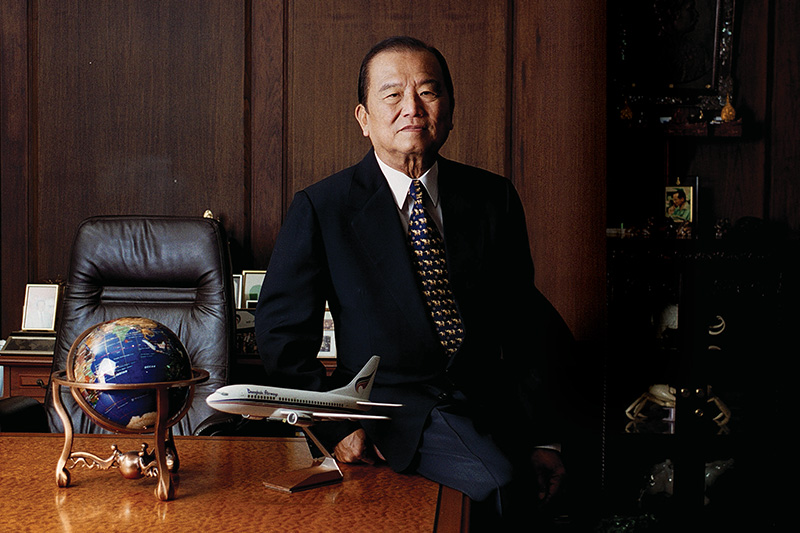
Giving Flight to Vision
Fah Thai remembers Dr. Prasert Prasarttong-Osoth (1932-2026), the visionary pioneer who rejected the corporate playbook to create Bangkok Airways — Asia’s Boutique Airline
Words: Fah Thai Team
Photos: Courtesy of Bangkok Airways
When Thailand reflects on the life of Dr. Prasert Prasarttong-Osoth, the collective memory turns to hospitals, healthcare, and the transformation of private medicine. Yet, these are just one dimension of a far larger legacy. Dr. Prasert was not merely
a physician who became a businessman, or a founder of major institutions. He was, more profoundly, a visionary who understood how systems shape nations, a builder of paradigms and a quiet architect of possibilities whose influence extended far beyond medicine to the advancement of Thailand itself.
His most enduring achievement was carrying his vision beyond hospital corridors and into the open skies. Bangkok Airways, perhaps his most distinctive enterprise, was never conceived merely as an airline. It was an extension of a deeper philosophy rooted in connection and accessibility – a belief that transportation should do more than simply move people from A to B, but actively redefine how they experience a country.
Born on March 22, 1933 in Bangkok, Dr. Prasert’s path into medicine was shaped by his studies at Assumption College, Triam Udom Suksa School, Chulalongkorn University’s pre-medical programme, and Siriraj Hospital, Mahidol University. His early years in surgery reflected discipline, precision, and an analytical mind, but they also hinted at something broader: an instinct not just for understanding the human system, but for recognising where larger societal systems were incomplete. He possessed a rare ability to identify absence, whether in healthcare, infrastructure, or opportunity, and imagine what could exist in its place.
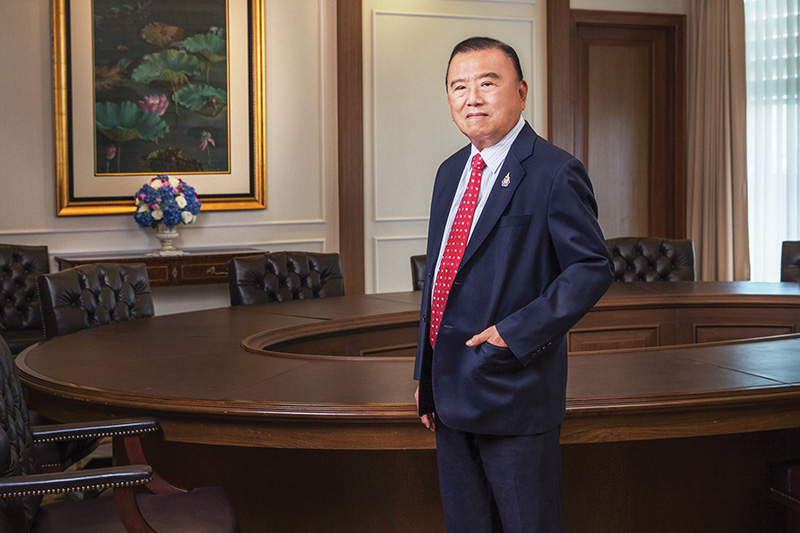


Mapping New Pathways
That instinct first transformed healthcare through Bangkok Dusit Medical Services (BDMS), putting Thailand’s private medical sector firmly on the regional map. But when his foresight turned toward aviation, it took on an especially transformative dimension. Rather than merely entering an established industry, Dr. Prasert anticipated a future that others could not yet see.
In 1968, under the name Krungthep Sahakol, he laid the foundation for what would become Bangkok Airways. By 1986, the airline was formally launched as Thailand’s first privately owned domestic carrier, marking not simply the birth of a new business, but a new way of imagining national connectivity. Its inaugural routes to destinations such as Krabi, Surin, and Nakhon Ratchasima reflected more than a commercial calculation. They revealed a man who understood that aviation could democratise geography, transforming distant provinces from peripheral destinations into reachable experiences and redefining how mobility could support development.
Where others saw routes, Dr. Prasert saw pathways.
This vision became even clearer with Koh Samui. When Samui Airport opened in 1989 as Thailand’s first privately owned airport, it represented far more than infrastructure. At
the time, Koh Samui was largely undeveloped, a far cry from the globally recognised destination it is today. Building an airport there required more than just investment; it took extraordinary foresight. Dr. Prasert recognised that transportation does not simply respond to demand, it can create it.
By establishing Samui Airport, Bangkok Airways did more than serve an island – it helped shape its future. The airport became a gateway through which Koh Samui evolved into one of Thailand’s top tourism destinations, demonstrating Dr. Prasert’s ability to see beyond present realities to future potential. This philosophy would later extend to Sukhothai and Trat, where aviation became not merely a means of transport, but a deliberate instrument for expanding Thailand’s tourism and regional landscape.

Cultivating the Boutique Experience
This was where Dr. Prasert’s genius became especially clear. He was never interested in aviation solely in the context of scale. Rather than competing on size or price alone, he cultivated distinction. Bangkok Airways developed an identity centred on traveller experience, strategic destinations, and thoughtful service, creating an approach that would eventually define its now-iconic positioning as “Asia’s Boutique Airline”.
When that identity formally emerged in 2004, it was not simply branding. It was the articulationof a strategy Dr. Prasert had long been building, one that favoured character, quality, and carefully curated experiences through boutique lounges, exclusive airport ownership, and routes designed not merely for traffic but for strategic cultural and economic value. Bangkok Airways carved a space uniquely its own within a rapidly changing aviation landscape.
Most importantly, it did so with a distinctly Thai sensibility.
Bangkok Airways never sought to imitate global aviation giants. Instead, it reflected a local philosophy of hospitality, elegance, and place- making. It presented Thai aviation not as derivative, but as original, capable of expressing national identity through service, design, and destination. For many travellers, Bangkok Airways became more than a carrier. It became an introduction to a side of Thailand that is not defined just by arrival, but by atmosphere.
This may be why Bangkok Airways occupies such a singular and emotional place in Thailand’s collective imagination. It is recognised not solely for transporting passengers, but for opening gateways to islands, heritage cities, and landscapes that may otherwise have remained less accessible. It helped shape not just movement, but arrival itself.

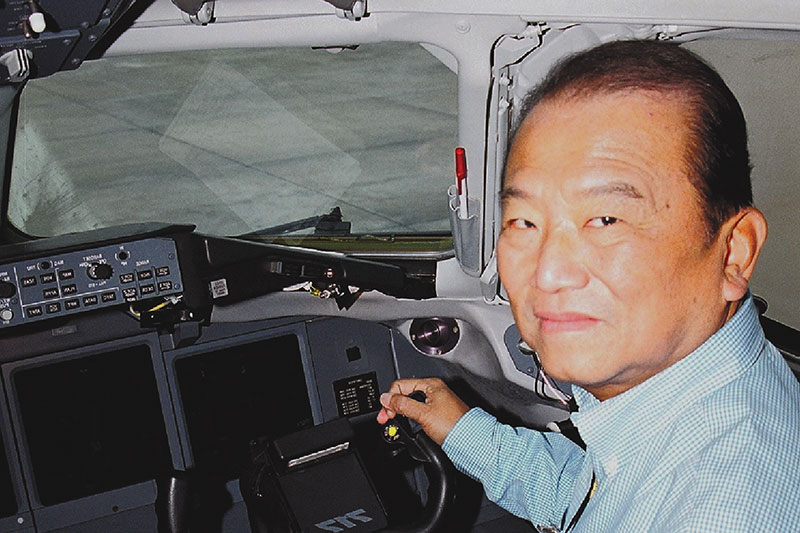
A Living Legacy
As leadership passes to the next generation, under the guidance of Captain Puttipong Prasarttong-Osoth, Bangkok Airways continues to evolve. This ongoing legacy is driven by airport expansions, infrastructure development, and future-facing projects in Samui, Trat, and U-Tapao. Yet even as the company advances, its underlying philosophy remains rooted in its founder’s original vision: sustainable growth, strategic development, and an understanding that aviation should serve as a long-term national asset.
Remembering Dr. Prasert solely for the institutions he founded would, therefore, be too narrow. His deeper contribution lies in how he reimagined entire systems. In medicine, he helped build networks of care that transformed healthcare. In aviation, he applied that same visionary sensibility to geography, creating frameworks that changed how Thailand could connect, travel and grow.
What distinguished him was his ability to view infrastructure not merely as construction, but as possibility in motion. In his hands, airports, routes and transportation networks were more than physical assets. They became mechanisms of transformation, bringing once- distant places closer and allowing tourism, commerce, and cultural exchange to flourish in ways that reshaped the nation.
There is, perhaps, a profound symmetry in this life’s work. As a physician, Dr. Prasert first learned that survival depends on circulation, on systems that sustain movement and connection. As an entrepreneur, he expanded that same principle to a national scale, building systems that allowed a country itself to circulate more dynamically, linking people, places, and possibilities.
This is why his aviation legacy endures so powerfully. Bangkok Airways was never simply about aircraft or airports. It was about expanding horizons, broadening access, and imagining how thoughtful infrastructure could shape a nation’s future.
His legacy is best understood not as something static, but as something living – carried forward each day in departures and arrivals, in the quiet ascent of aircraft over the shoreline, and in the continued opening of destinations once considered beyond reach.
For generations to come, Bangkok Airways will continue to modernise, adapt, and expand. Yet, woven into its identity will always be the founding vision of the man who first understood that aviation, at its best, is not merely a business of transportation, but a bridge between where a nation stands and where it might yet go.
In that sense, Dr. Prasert Prasarttong-Osoth did far more than build organisations. He opened new paths for Thailand to progress and move forward.