
Thailand’s Technicolour Travelling Theatres
Centuries-old legends unfold in the fluorescent hum of temple fairs, as dazzling Likay performers battle for laughs with their audience
Words: Phoowadon Duangmee
Photos: Shutterstock
On the edge of a temple fair in Thailand, the light seems harsher – fluorescent tubes strung across a clearing buzz faintly over rows of plastic chairs. Smoke from grilled pork hangs low, drifting over the crowd. Children skip between stalls clutching plastic cups of pop, while older spectators settle in, leaning back like they know what’s ahead.
It’s not obvious, but the performance has already begun. Above the chatter and scraping of chairs and someone calling out an order, a thin melody snakes through the air. It builds slowly, drawing eyes towards a small stage with a painted backdrop.
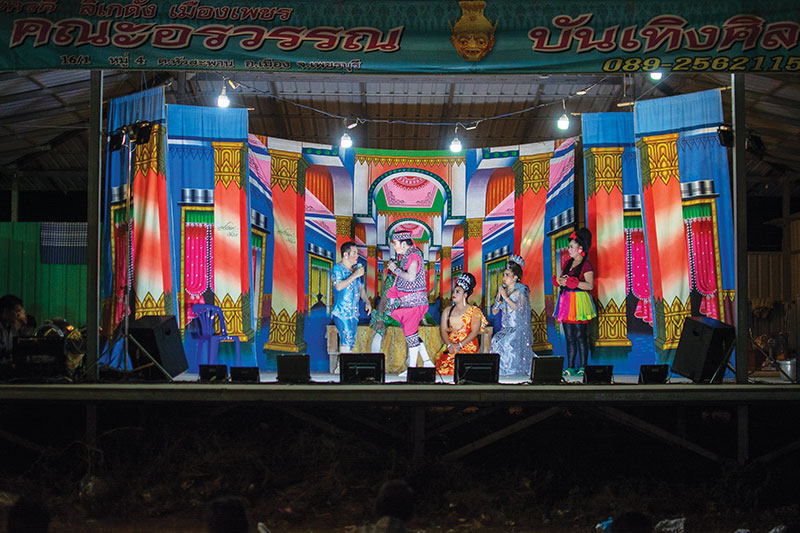
This is Likay – Thailand’s itinerant folk theatre. The stage is simple. A wooden bench sits in the centre with a backdrop that could be mountains or a palace hall depending on the angle. The curtain – a hanging sheet – hides a narrow space where costumes are tugged into place and makeup is checked in a small mirror.
Finally, the performers emerge on stage, and everything shifts.
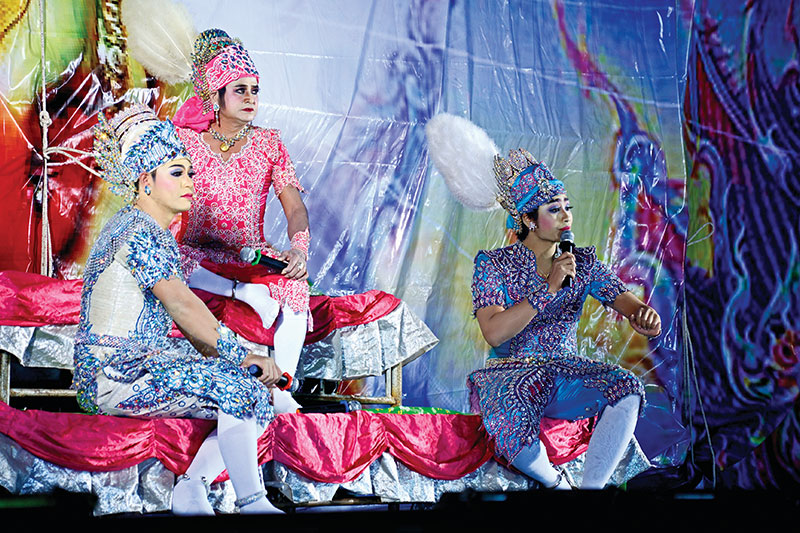
One steps forward, his sequinned costume and imitation jewellery catching the light as he tilts his headdress slightly to signal the start of the dance. The opening note wavers before settling. His hands follow with stylished gestures.
Likay, sometimes called Yike (pronounced yi-ke), is a centuries-old heartbeat of Thai community life, pulsing through temple fairs, village gatherings, joyful ordinations and sombre funerals. In contrast to the cold grandeur of royal arts, the audience gets involved from the beginning, shaping performances with spontaneous jokes and witty responses.
Its roots are deep and many-layered. Scholars trace Likay back to older performance traditions influenced by Malay and Persian-Islamic storytelling. Over time, it absorbed elements from classical Thai theatre like Khon and Lakhon, adopting their glittering costumes and elegant gestures while shedding their rigidity. What remains is a fluid art form that endures because it never stops adapting.
The stories follow familiar arcs: Princes cast into exile, lovers separated and reunited, scheming villains who inevitably meet their just deserts. Yet the scripts are never fixed. They stretch, contract and bend at the whim of the crowd. No two nights are ever the same.
The stories follow familiar arcs: Princes cast into exile, lovers separated and reunited, scheming villains who inevitably meet their just deserts. Yet the scripts are never fixed. They stretch, contract and bend at the whim of the crowd. No two nights are ever the same.
Troupes have introduced modern innovations in recent years. Painted backdrops have given way to LED screens, and the latest Luk Thung hits now punctuate traditional rhythms. A tragic prince may suddenly pause to deliver a contemporary song, breaking character without breaking the spell.
Yet, modern life is also applying a different kind of pressure. Fewer youngsters show up at temple fairs, and when they do, the glow from phones competes with the fluorescent lights above. The crowd thins at the perimeters, and the attention – once held collectively – now fragments easily.
Yet something holds.
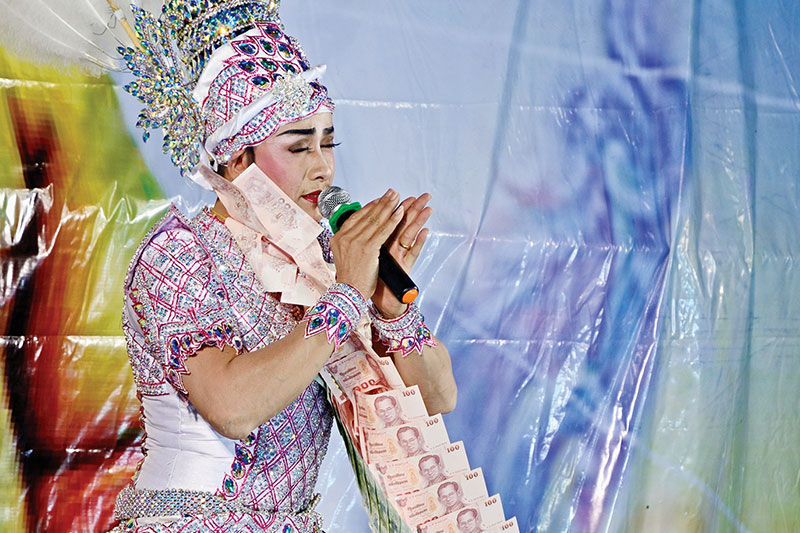
At the edge of the stage, she waits – composed, attentive, unmistakable. Mae Yok – typically a middle-aged female patron devoted to the lead actor – steps forward and gently places a garland of folded banknotes around his neck. The gesture draws laughter, applause and knowing looks from the stage.
Her role, however, extends beyond a single night. The Mae Yok follows her favourite troupe from one performance to the next, hiring them for events and sustaining them behind the scenes. What once began as shared meals or small offerings has evolved; her support may now take the form of gold, cars or even full financial backing for the troupe.
Yet, the core of Likay remains unchanged: soulful melodies, scintillating costumes and raucous audience participation.
As the performance unfolds, a prince declares his devotion in song – his voice carried by the rhythm of the traditional Piphat ensemble (xylophones, drums and reed pipe). The music nudges, signals and occasionally pulls the performance back in line.
As the action intensifies, a comical figure slips onto the stage. Scanning the crowd, he jokes about rising prices, hot gossip, politics and other social issues. Another actor singles out a member of the audience, who tries to wave him away with a smile. The performance has taken a swift turn, striking up a lively dialogue with the audience.
In Likay, the boundary between stage and crowd dissolves in a riot of improvisation. Performers move fluidly between singing verses and spoken dialogue. One moment they sound distant and formal, the next they are chatting about current events.
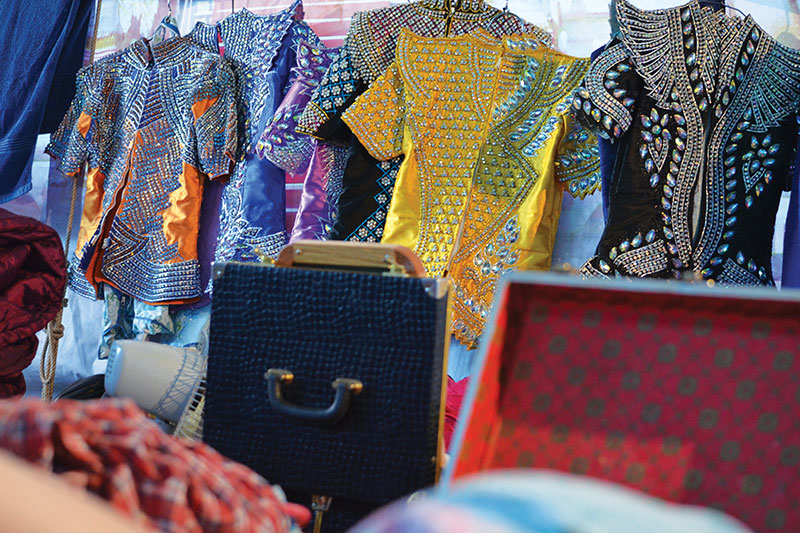
Behind the curtain, the magic gives way to more practical concerns. The dressing area is narrow, lit by a single flickering bulb. Costumes, heavy with sequins fixed by metallic thread, are adjusted again and again. Thick makeup is applied to withstand the harsh light. Performers sit in silence, partially dressed, waiting to be called back into the fray.
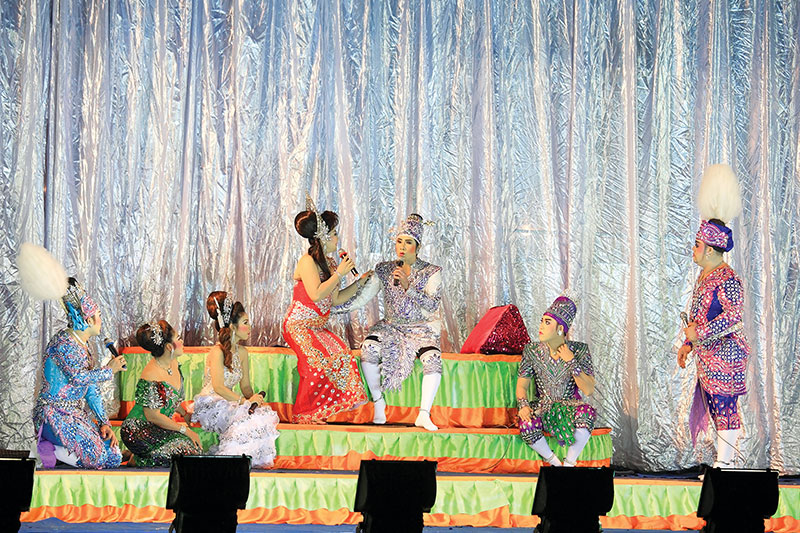
The style leans towards gaudy excess. Towering headdresses rise in tiers and colours are unapologetically bright – a spectacle designed to cut through distractions and command attention in even the most chaotic settings.
Travellers familiar with other Southeast Asian performance traditions may recognise Likay’s rhythms and gestures, yet the art form defies categorisation. It flows seamlessly between formal and informal, ceremonial and casual, moral lessons one moment and jokes the next.
As the night deepens, the story climaxes, resolves, and then begins all over again. Lovers are tested and reunited. Villains reveal themselves in a predictable yet satisfying manner. Restless child viewers start to settle, while older members of the crowd lean in to catch the lyrics.
Likay persists as both an art form and a social glue, drawing people from all walks of life together and momentarily erasing the boundaries of status and age.
Near midnight, the final sequence arrives. The resolution is clear – virtue is rewarded and balance restored. The audience applauds, though not for long. People stand, stretch and drift toward the food stalls. Conversations resume where they left off. The lights continue to hum.
Backstage, the headdresses, wigs and costumes come off. The stage empties, returning to its original form – a platform, a backdrop, a few scattered chairs.
If you’re travelling through Thailand, it’s easy to miss Likay. It doesn’t announce itself with neon lights or stadium roars. There are no ticket booths or fixed schedules set weeks in advance. Instead, it appears whenever and wherever it is needed, sometimes for a single night, before disappearing back into the landscape.