

The Secret Sides of Chiang Mai
You may know its city wall and mountain vista, but the former Lanna capital still holds a multitude of unexpected discoveries
Words: Pinanong Panchuen
Photos: Pinanong Panchuen, Anutra Ungsuprasert, Sanpakoi Street Market and Shutterstock
Childhood memories, familiar flavours, old photographs, beautiful architecture and a century-old rain tree flipped on its head reveal a new side of the city we thought we knew well.
Chiang Mai is an old favourite with many tourists, but beyond the temples, mountains and neighbourhoods we keep returning to, the former Lanna capital is filled with hidden treats tucked into unexpected corners.
Sometimes it’s the flavour of a local childhood snack, at others an old photograph, a moss-covered forest sanctuary, a tree transformed by the rising waters of a reservoir, or a book on a shelf. Look a little closer, and Chiang Mai starts feeling unfamiliar again.
Bites of Sweet Nostalgia
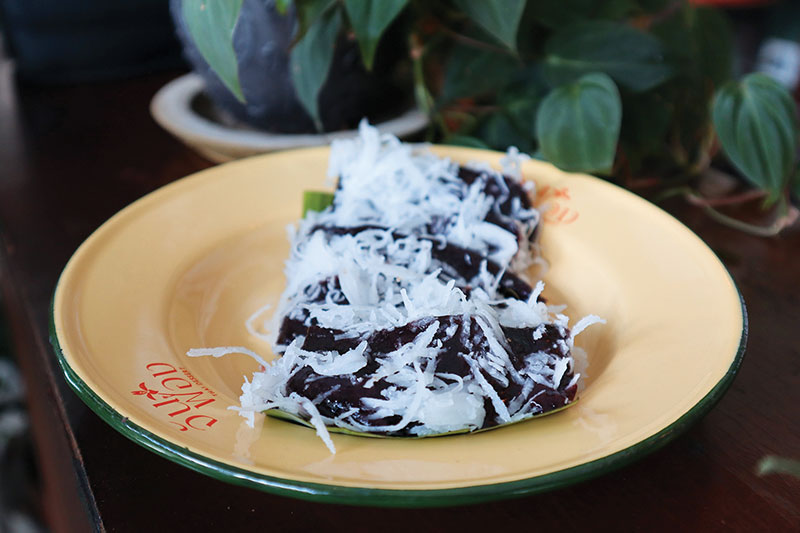
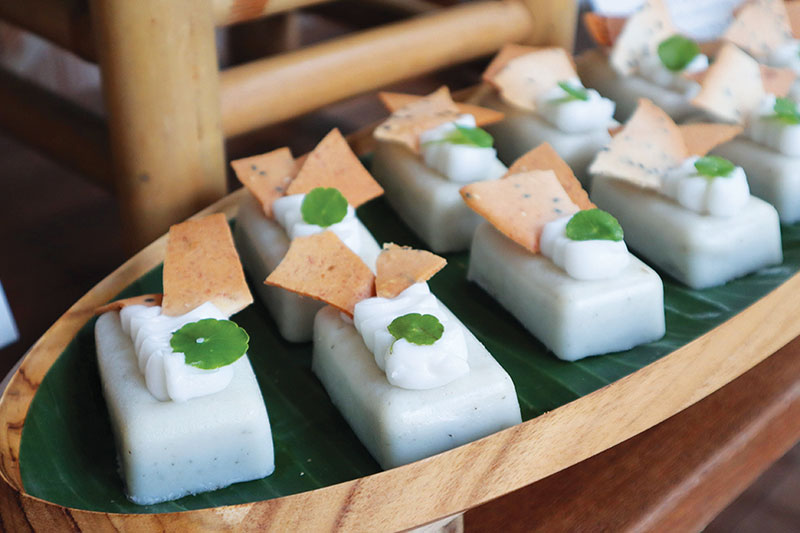
Khanom Kluea, Khanom Hang Mu and Khanom Lin Ma hardly ever appear on checklists of essential Chiang Mai dishes, so finding them will take effort. Your best chance to discover these simple local sweets is at early-morning markets, which offer an authentic taste of everyday life in the North.
These delightful confections are made with modest ingredients: rice flour, coconut milk, salt and sugar. But their real significance lies in the memories attached to them.
A Chiang Mai friend fondly remembers eating Khanom Kluea – a soft, steamed treat wrapped in banana leaf – before leaving for school in the morning or tucking into it for comfort when unwell. The sweet has simple ingredients and is easy to make. Rice flour is mixed with water or coconut milk, salt and sugar, and simmered until soft. The concoction is then wrapped in banana leaf and steamed.
Some families add Nam Wa banana for extra sweetness and texture. You can find both the plain and banana-filled versions made from recipes passed down generations at many morning markets.
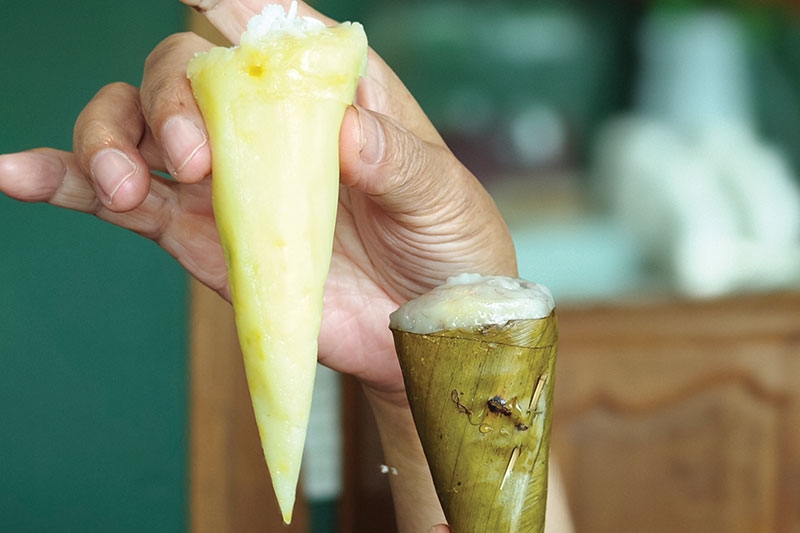
Khanom Hang Mu (pig’s tail) – also known as Khanom Hang Nu (mouse’s tail) or Khanom Hang Chingchok (lizard’s tail) – comes in a long banana-leaf cone.
The basic ingredients are the same as Khanom Kluea, but include more banana, pumpkin or Thai melon. Once unwrapped, this gelatinous sweet tapers to a wiggling point that inspired the tail-related names. The sweet continues to amuse children and has remained a favourite with many adults.
Then there is Khanom Lin Ma or “dog’s tongue”. Black sticky rice flour replaces ordinary rice flour, giving the steamed rectangular parcel its dark colour and distinctive appearance. People’s imagination did the rest.
These humble sweets are now being restored to the menu at local dessert cafés, where they are given a more contemporary presentation. But for the authentic experience, wake up early and head to your nearest market. Sometimes Chiang Mai’s past is best sampled still warm from the steamer.
Stepping into a Vintage Frame
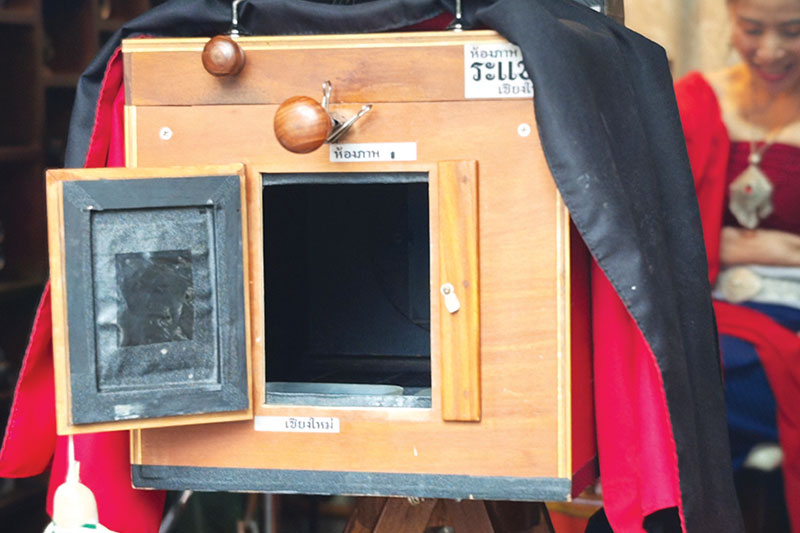
No time machine is needed to travel back through the centuries, just book a 15-minute session at Rakaeng Photo Studio.
Nestled behind Wat Ton Kwen (Wat Intharawat) in Hang Dong district, this cosy, vintage photography studio uses traditional light-sensitive photographic paper to create portraits that capture the mood of a bygone era.
Instead of relying on lavish royal costumes and grand sights, the studio transports visitors back to authentic scenes of everyday Lanna life – quiet, natural and deliberately unpolished.
“I always tell customers that I’m not a professional photographer, just a craftsman in love with his craft,” says Theerasak Bua-on. “The idea is to create images of the ordinary way of life during Lanna times. I want to preserve images in this mood and tone, so future generations have something to look back on.”
Visitors can arrive in a costume of their choosing or rent an outfit from one of the shops nearby before joining the queue. Once the photograph has been snapped, it will take around 15 minutes to be developed.
Rakaeng Photo Studio
Tik Tok: @rakhaeng.photogra
Open daily except Tuesday, 8.30am to 4.30pm
Portraits: Single: 250 baht; Couple: 300 baht
Stories Etched in Wood and Stone
Two very different temples in Chiang Mai offer visitors a glimpse of the full spectrum of northern Thai architecture. One is precise and beautifully designed, while the other appears to have grown organically out of a garden.
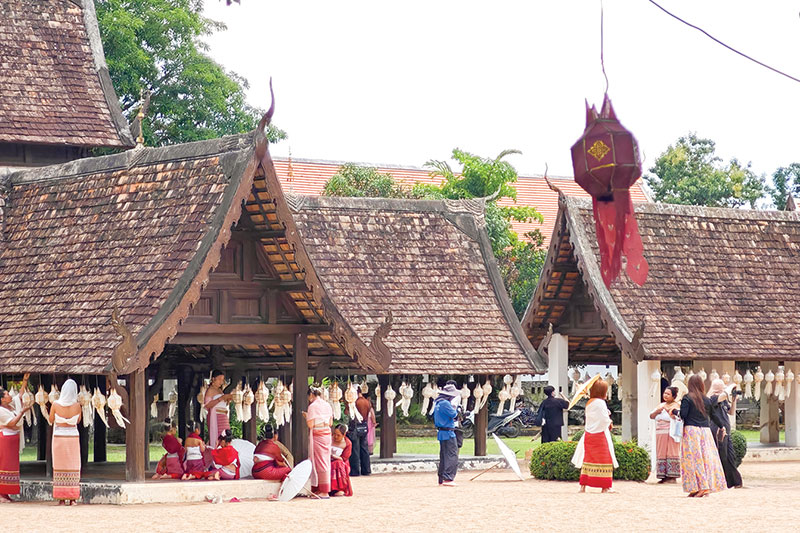
Tucked away in compact grounds, Wat Ton Kwen is an icon of traditional Lanna architecture and a precious site for studying the art, history and culture of northern Thailand.
The heart of the temple is the Viharn, or main sermon hall, with its distinctive four-gabled wooden pavilion in front and galleries within. The hall takes up most of the grounds. The temple was named after the ton kwen, or jujube trees, that once grew on this spot. Today, only one of these giants remains, standing guard over the temple.
The temple’s sermon hall inspired the magnificent Royal Pavilion at Royal Park Rajapruek, which was built for the landmark international flower show.
The temple’s pavilion and covered walkways have long caught the eye of architects and designers interested in traditional Lanna architecture.
Wat Ton Kwen
Nong Khwai, Hang Dong Near Royal Park Rajapruek
Perched on the slopes of Doi Suthep overlooking Chiang Mai is a temple with a very different mood.
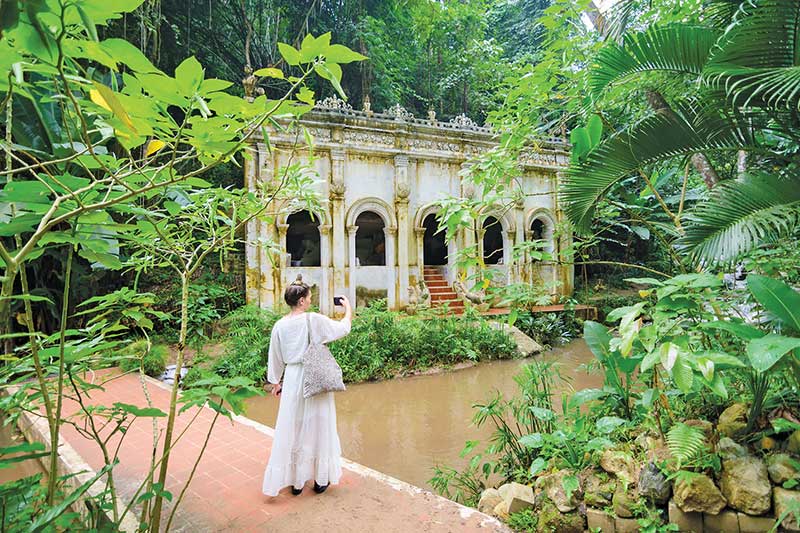
Wat Pha Lat (Wat Sakadagami) was built in the 14th century and served as a rest stop for pilgrims making their way to Wat Phra That on the peak of the mountain. The name Pha Lat comes from the northern Thai word for slipping or sliding, referring to the steep road to the temple that often caused travellers and even elephants to take a tumble.
The temple’s most eye-catching feature is the Ho Phra Chao Rim Nam Tok, an openair gallery of Buddha statues shaded by a dense canopy of trees next to a stream. Its striking design of arches and stucco peacocks and plant motifs is thought to have been inspired by Western and Burmese influences. Forest, water and stone blend with stunning architecture to create a serene and atmospheric sanctuary.
Wat Pha Lat
Suthep, Mueang Chiang Mai

The Mirrored Giant
Nature sometimes paints a familiar landscape in surreal shapes.
At Mae Ngat Somboon Chon Dam in Si Lanna National Park, a century-old giant rain tree is a seasonal rather than a permanent attraction, drawing visitors only when reservoir waters rise to cover its trunk, leaving its broad canopy mirrored on the still surface.
Known locally as Chamcha Klang Nam, the tree sits within the Si Lanna National Park reservoir. The best time to catch this natural wonder is between September and February, when rain lifts the water level. Take a boat trip across the reservoir for a close-up view of the “floating tree” and its picturesque surroundings, making sure to use authorised local boat operators and guides registered with the Department of National Parks, Wildlife and Plant Conservation.
Si Lanna National Park
Tel: 053 479 079
Facebook: Si Lanna National Park
A Hidden Literary Sanctuary
The buzz of the city falls silent as you step through the gates of the École française d’ExtrêmeOrient Chiang Mai Library (EFEO Chiang Mai) and.
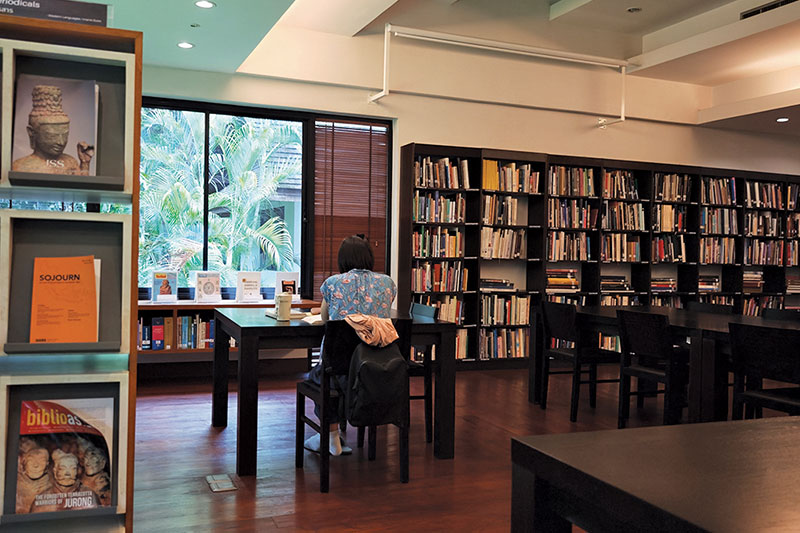
Set in a leafy garden with traditional Lanna-style wooden buildings, the library offers a sanctuary of rustling leaves, blooming flowers, and the gentle hum of insects.
Open since 2011, the shelves hold roughly 50,000 books in Thai, French, English and other languages, with a focus on civilisations, literature, art, history, archaeology and the linguistics of Southeast Asia, especially Thailand.
Among the most cherished titles is Tamnan Phra Phim, a Thai translation of The Legend of Votive Tablets – a pioneering study on Thai Buddhist votive tablets and amulets by French scholar and epigraphist George Cœdès.
Another intriguing find is Maha Pho, editions of a magazine devoted to Thai Buddhist amulets. Its pages have long served as a precious reference for collectors of sacred Thai talismans and how to tell if they are authentic.
But you don’t need to be a scholar to spend time here. This corner of Chiang Mai offers something very rare – tranquillity and no pressure to do anything but read, look and linger.
EFEO Chiang Mai Library
www.efeo.fr/centre/chiang-mai
Open Monday–Friday, 9am-4.30pm Charoen Prathet Road, Chang Khlan, Mueang Chiang Mai
Bazaar Discovery
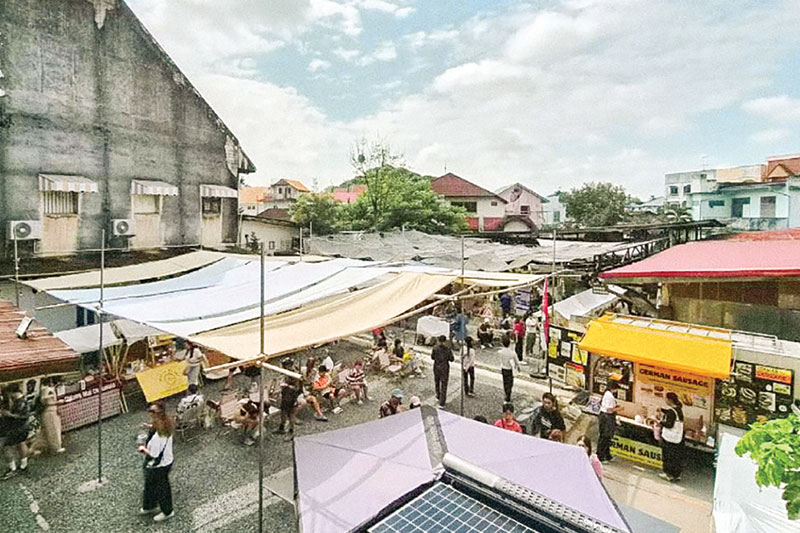
The best finds are often made by accident. A visit to check out the wares at Wasin Thai Textile Shop led us to another discovery: Sanpakoi Street Market – a community bazaar that injects an old Chiang Mai neighbourhood with a lively Sunday morning buzz.
Food stalls jostle for space with coffee stops, crafts, workshops and live music. Vendors range from youngsters selling innovative souvenirs to old-timers with more traditional wares, creating a market that feels more like a neighbourhood get-together than a retail event.
The market takes place on the first Sunday of each month, from 8am to 1pm. Arrive early for breakfast and coffee before you wander around the craft stalls or join a workshop. Choose from pottery, sketching, knitting, weaving, and more.
Sanpakoi Street Market
Anusarn Building, Charoen Mueang Road, Wat Ket, Mueang Chiang Mai
Chiang Mai may have once been the Lanna Kingdom’s capital, but its past is not confined to monuments or museum displays. History here is served fresh – in dishes steaming as the sun rises, photographs developed by hand, beautiful old buildings gilded with lichen and moss, books waiting quietly to be discovered and vintage neighbourhoods that buzz with new purpose.
Returning to Chiang Mai rarely feels like repeating the same journey. The city always keeps a few secrets hidden away.