
Where the Gods Came Ashore
On Koh Samui, the Hainanese community keeps alive rituals shaped by ocean crossings, ancestral memory and unwavering belief
Words Luo Bing
Photos Valentino Pangchalong & Jiraphol Rikshasuta
Carried by tides and sustained by faith, the Hainanese people of Thailand have preserved a spiritual world that is increasingly rare in the modern age. A precious example is Koh Samui, where sacred tiger dances, fire-walking and celestial rituals are practised as a living tradition. Heritage here is not hidden in museums but performed daily as part of ordinary life.
Chinese migrants began trickling into Thailand during the reign of King Rama III (1824-1851), but it was under King Rama V (1868-1910) that the movement surged. The turning point came with the signing of the Bowring Treaty between Siam and Great Britain in 1855. This landmark agreement opened the Siamese kingdom to international trade, accelerating economic growth and reshaping the country’s relationship with the outside world. Commerce expanded, agriculture and industry flourished, and Chinese migrants arrived in growing numbers – trading, investing and seeking opportunities on foreign shores.
The migrants came from several distinct Chinese groups: Teochew, Hokkien, Hainanese, Cantonese and Hakka. They are collectively known as Ngoh Hok – the five major Chinese groups in Thailand – although they are often referred to simply as Thai-Chinese today.
Over generations, Thai and Chinese identities have blended so seamlessly that the boundary between them is often difficult to define. Chinese values such as diligence, perseverance, thrift and loyalty quietly wove themselves into the Thai spirit of warm-heartedness, generosity, tolerance and sanook (fun).
Yet despite this metling pot, many Chinese communities in Thailand retain a strong sense of cultural continuity. Across the country, Chinese shrines, schools and language associations stand as quiet witnesses to this heritage. Rituals once practised privately wihtin communities have evolved into national events, with celebrations like Chinese New Year and the Vegetarian Festival now firmly fixed on the calendar. Among Thailand’s many Chinese communities, however, one group stands out for the depth and resilience of its traditions: the Hainanese.
A People Shaped by the Sea
Thais of Hainanese descent trace their roots to Hainan Island, China’s southernmost province. Historically remote and surrounded by ocean, Hainan shaped a people intimately connected to the sea. Though distant from political and economic centres, the island was rich in natural resources and its geography shaped a culture marked by independence, adaptability and a strong artistic sensibility.
As Hainanese migrants spread across Thailand, many headed for Bangkok – particularly to the Samsen, Bang Pho and Bang Sue districts. Others settled beyond the captial in Nakhon Sawan, Phichit, Lampang and Chiang Rai. Perhaps the strongest magnet, however, was Surat Thani province, particularly Koh Samui, where the rhythms of island life echoed those of their ancestral home.
Central to the Hainanese identity is a deep bond between ancestors and descendants. Cultural knowledge, moral values and unique rituals are handed down from generation to generation. Even after more than a century in Thailand, this careful transmission has allowed local Hainanese to preserve a distinct sense of identity, grounded in memory yet lived out in the here and now.
This living heritage was praised by King Rama V, who wrote: “The Hainanese cherish art and beauty, and their craftsmen are distinguished by grace and refinement.”
Many of the migrants became skilled carpenters or sawmill owners – a legacy that is still visible today. Intricate woodcarvings found in Hainanese shrines, along with the painstaking restoration of sacred statues – smoothing, lacquering, gilding with gold leaf and repainting with bright colours – shows a reverence both for craftsmanship and for the divine itself.
Belief as a Way of Life
When it comes to faith, Hainanese beliefs closely mirror those of Thais. Spirit worship, belief in karma and moral teachings influenced by Confucianism and Mahayana Buddhism form the foundation of daily life. Great imortance is placed upon virtue, gratitude towards ancestors and honouring one’ word.
These values come alive in a rich calendar of rituals and festivals, from Chinese New Year and the Ghost Festival to elaborate funerary rites such as Gong Tek to ensure safe passage of departed loved ones into the afterlife. At the centre is Hainanese opera, which serves both as entertainment and a stage to strengthen bonds of language, memory and tradition.
For the Hainanese, deities are not distant symbols but daily companions – protectors helping to shape their lives. Migration often meant perilous journeys across open seas in small boats at the mercy of wind, waves and pirates. In these moments, faith became essential and legends took shape.
Traditionally, sacred images were painted or carved only for deities who took up residence in a permanent home – a shrine, household altar or trading vessel. On migrant journeys, devotion took a lighter form: Red paper inscribed with the deity’s name or sacred flags could be carried easily across land and sea. Deities might be invited temporarily for a ceremony, then respectfully bade farewell as ritual texts were burned to mark its conclusion.
Today, there are 135 recognised Hainanese shrines across Thailand. Most are dedicated to the Goddess of the Sea, Jao Mae Tubtim. “Whereever there are Hainanese, there is a Jao Mae Tubtim shrine,” goes the saying. On Koh Samui, no less than four Hainanese shrines stand as quiet sentinels of faith, history and maritime identity.
Witnessing a Rare Tradition
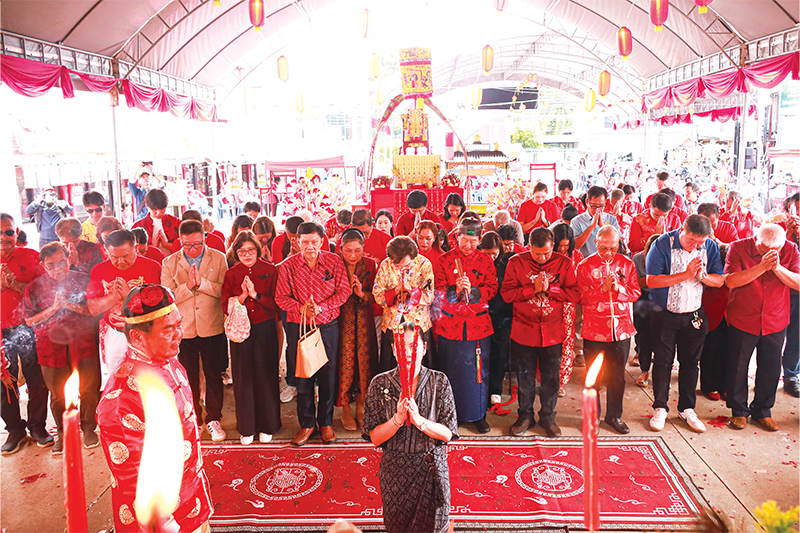
In December last year, Fah Thai was lucky enough to witness one of the most elaborate Hainanese rituals still practised today, an event becoming rare even in China. The occasion was the unveiling of a new sanctuary within the Guan Yu Shrine in Na Khai-Hua Thanon, built to welcome additional Hainanese deities. The consecration ceremony on December 14 and 15 featured the changing of sacred vestments and the “eye-opening” ritual – formal invitations for the divinity to take up residence in the newly restored images. Prayers were chanted in the Hainanese language, led by a priest from Hainan Island itself.
No mere religious rite, the ceremony was an act of cultural preservation – honouring the ancestors who settled on Koh Samui over a century ago and keeping their traditions vibrant and intact for future generations.
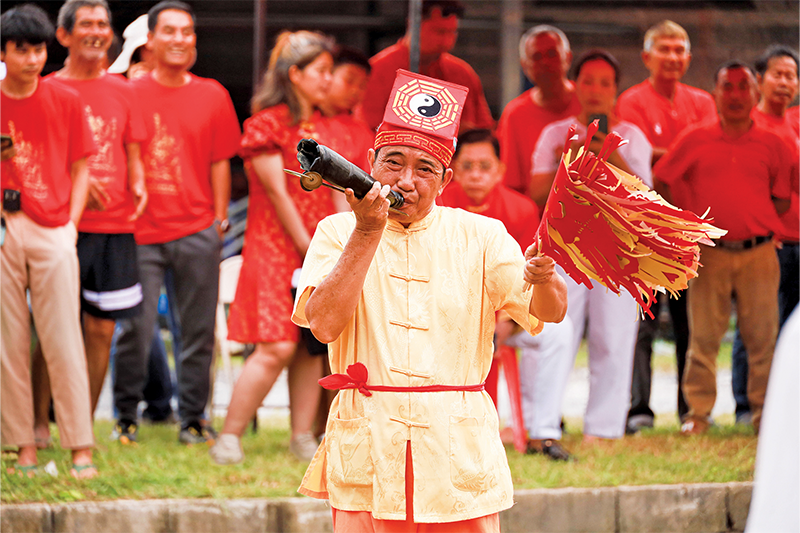
Changing Sacred Vestments and Awakening Deities
The ceremony began at dawn when six deities were invited to descend, led by Guan Yu and Ban Thao Kong, the guardian spirit overseeing the rite. Enthroned on ornate sedan chairs, their statues were borne down from the upper levels of the shrine to join the Goddess Tubtim in her two manifestations – Tian Hou Teng Mai and Tui Bui Teng Niang – as well as Yidi Gong, guardians of the sea, and Hua Guang Gong, God of Performance.
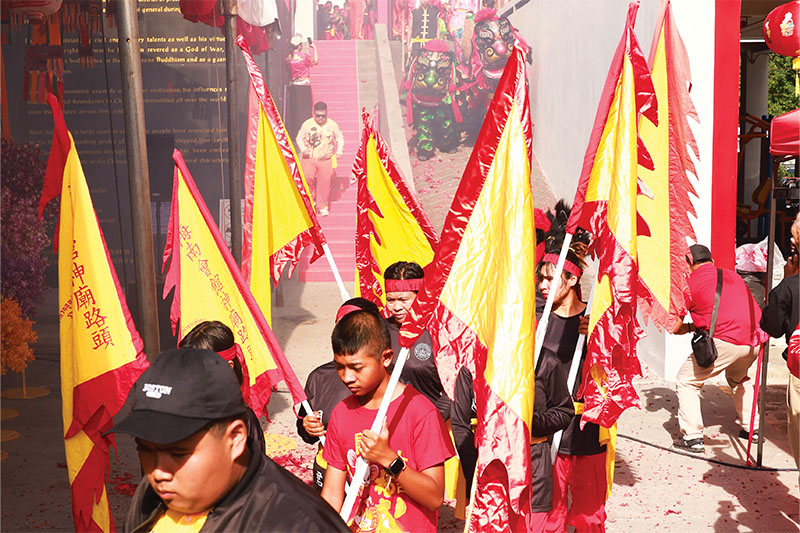
The deities were escorted to the ceremonial altar by the Tiger Troupe from Nakhon Sawan’s Thevarak Shrine. Firecrackers shattered the silence, signalling to Heaven and Earth that sacred proceedings were underway. The ritual reached its climax with the “eye-opening” ceremony, inviting the divinities to inhabit their restored images.
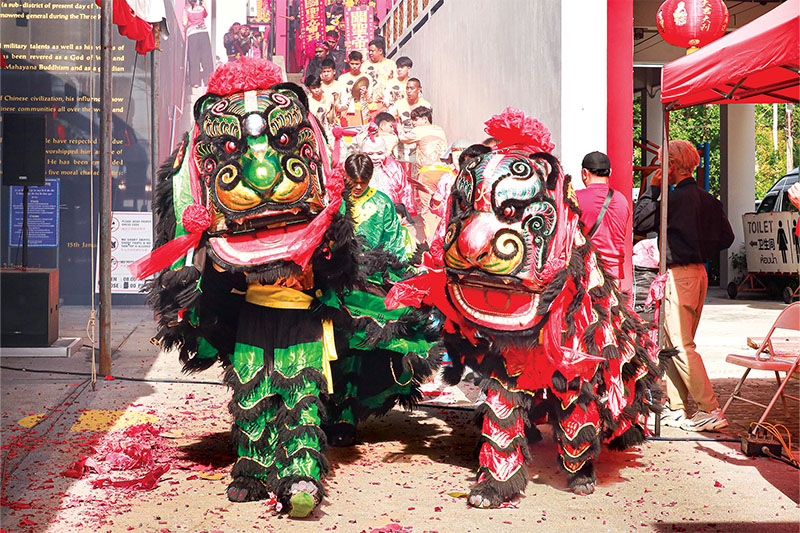
Tiger Dance Ritual
For Hainanese, the tiger embodies the guardian spirit Ban Thao Kong, known in Thailand as Thapharak. Traditionally, the tiger leads the enshrinement procession, clearing obstacles from the path and shielding devotees from harm. Symbolically, the Tiger Troupe became the festival’s spiritual vanguard – sweeping away malevolent forces so blessings may follow.
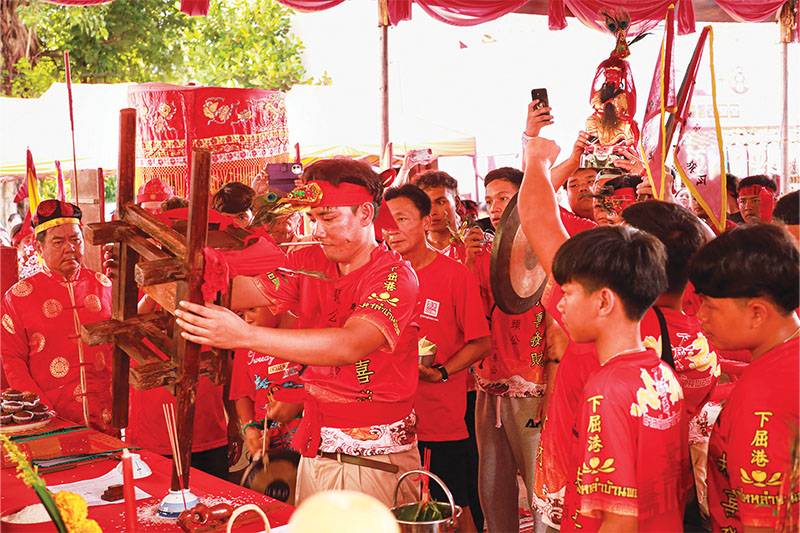
The Kan Luan Ritual
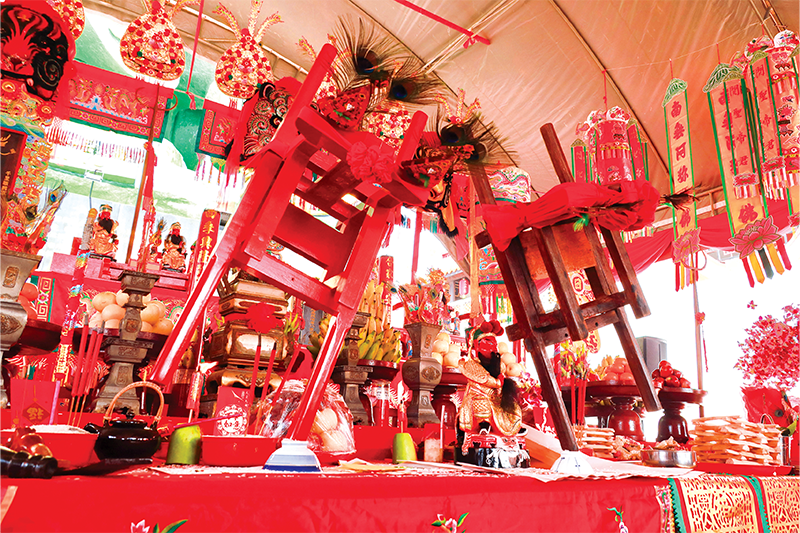
The Kan Luan ritual sees the deity’s spirit invited to descend through a spirit medium and take residence on the sedan throne, or Luan. The crucial point comes with the Luan balanced at an improbable angle, often resting on a single leg placed on the mouth of an inverted bowl or vase. This suspension, believed to be guided by divine force rather than human strength, serves as proof that the deity has fully descended. If balance cannot be achieved, the ritual is considered incomplete. Performed on December 14 by a spirit medium from Ban Phot Shrine in Surat Thani’s Don Sak district, the ceremony offered a glimpse into one of the most elusive and sacred rites of the Hainanese people.
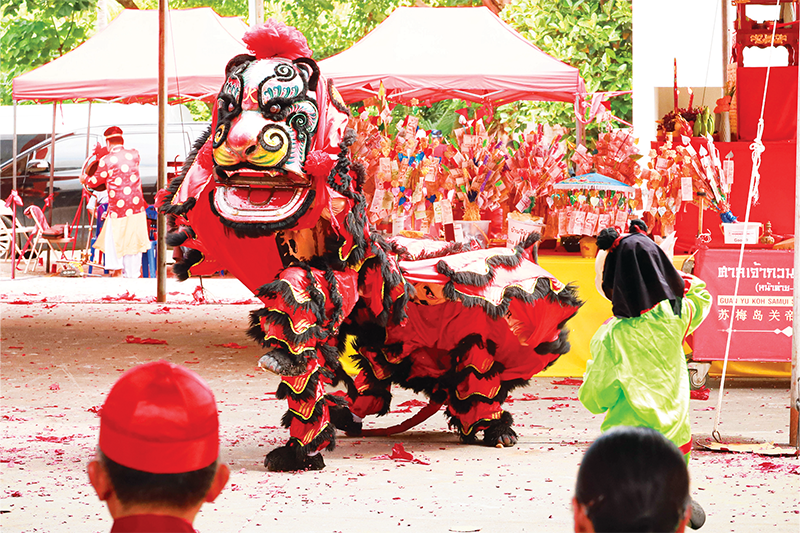
A Battle for Salvation
The legend behind the ceremony tells of a tiger that devoured a child in a moment of rage. The boy had been teasing the sleeping tiger, which turned around and swallowed him whole. Moved by the mother’s grief, Ban Thao Kong commanded the tiger to spit out the boy unharmed – a story since transformed into a dramatic ritual, embodying divine justice and mercy.
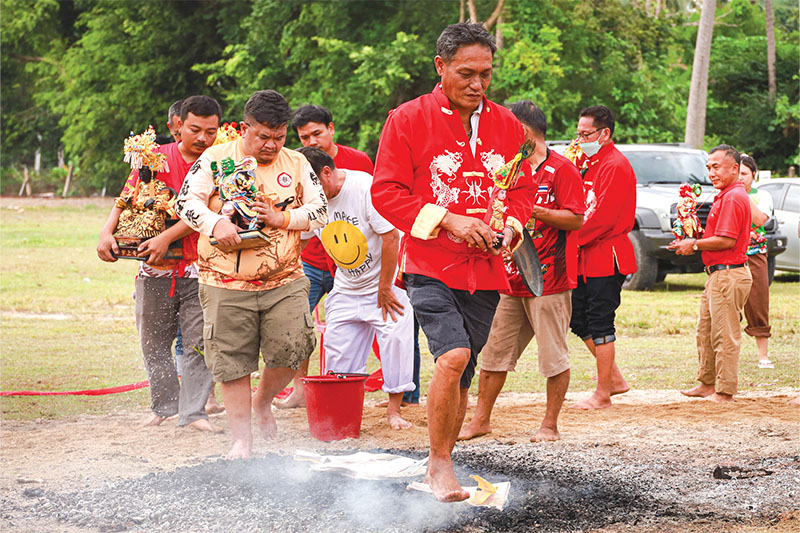
Fire walking Ritual
Participants walk barefoot over smouldering embers while carrying sacred images, believing fire to be a purifying force. Passed down through generations and traditionally performed within shrine grounds, the ritual takes place every five or 10 years, when artisans carefully remove the old layers of paint from each sacred statue before repainting them anew. The rite demands unwavering faith and courage, restoring spiritual clarity and potency.
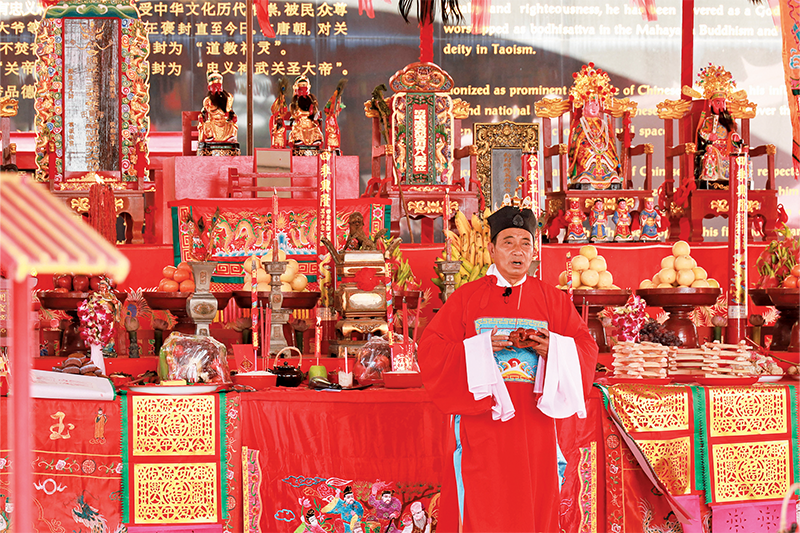
The Jian Biao Rite
In the Jian Biao ceremony, or the Rite of Petitioning Heaven, written petitions (biao) are prepared with great care and symbolically sent heavenwards to the highest celestial authority – the Jade Emperor. Ritualists chant formal invocations as offerings of incense, candles and symbolic items are made. The written petitions are then burned to confirm that the heavens have been formally informed and respectfully engaged. Among the Hainanese, the Jian Biao ritual is essential, marking the completion of the ceremony as blessings are sealed and faith and spiritual balance restored.
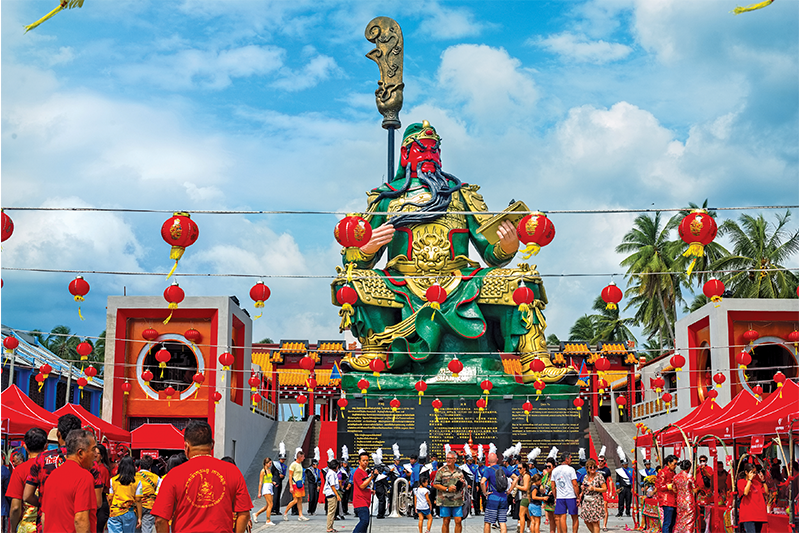
The God Guan Yu
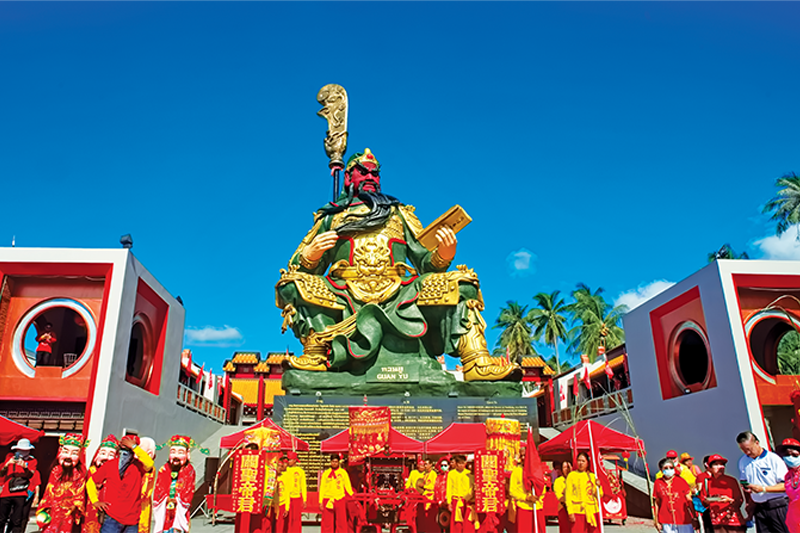
Born in Hedong Commandery, present-day Yuncheng in Shanxi Province, Guan Yu was a legendary general of the Three Kingdoms. Honoured in Taoism for his loyalty and integrity and deified as a god of wealth, he is also revered in Chinese Buddhism as a protector, warrior and moral paragon.
With his commanding image – red-faced, bearded and wielding the Green Dragon Crescent Blade – Guan Yu remains a symbol of righteousness. Shrines dedicated to him can be found across China, Taiwan, Hong Kong and Chinese communities worldwide, with worshippers seeking his protection and blessings for success in career and commerce. Guan Yu statues are commonly seen in homes, shops and offices, serving as a silent guardian of integrity and prosperity.
Guan Yu Shrine, Koh Samui (Na Khai-Hua Thanon)
Established in 1857 and sanctified with finely carved images of Guan Yu and Ban Thao Kong, the Guan Yu Shrine has long served as a spiritual anchor for Koh Samui’s Hainanese community. In its early years, the temple provided shelter for newly arrived Chinese migrants, granting them a sense of belonging far from home.
Today, it stands as one of the island’s most significant cultural landmarks – a living testament to faith, migration and the enduring legacy of the Hainanese people.